
Choosing between to fast or too fast can be confusing because the expressions sound alike but have different meanings. Using the wrong word can change your message, especially when writing an email, completing schoolwork, or publishing an article.
Fortunately, the rule is simple once you understand the difference. Learn when to use too fast for excessive speed and when to fast correctly describes the action of abstaining from food.
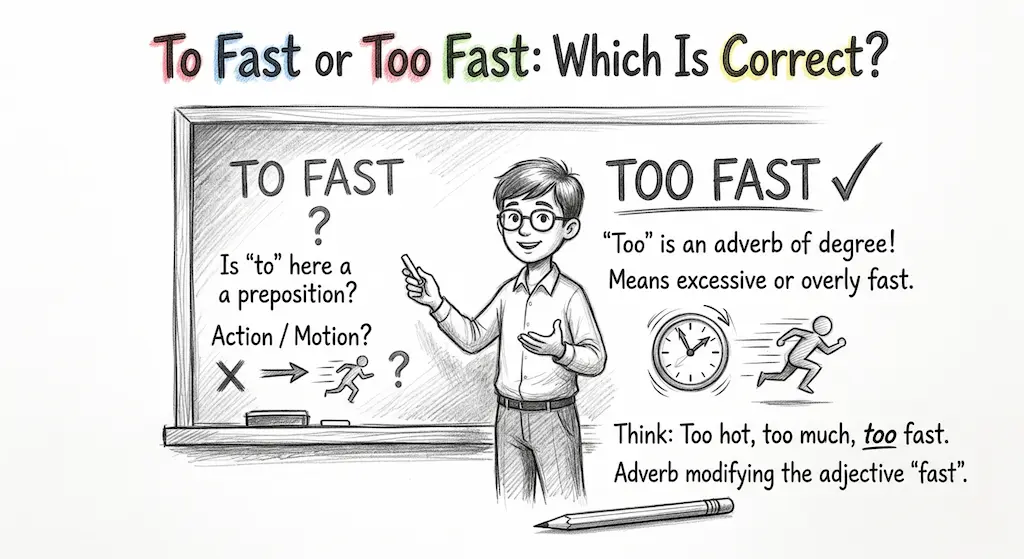
To Fast or Too Fast: Which Is Correct?
Both “to fast” and “too fast” are correct English expressions, but they are not interchangeable. Your intended meaning determines which one you should use.
Use too fast when something happens more quickly than is appropriate, comfortable, or desirable.
Examples:
- The driver is going too fast.
- My teacher is speaking too fast for me to understand.
- The video is playing too fast.
- You are typing too fast to check your spelling.
Use to fast when fast is a verb meaning to abstain from food for a period of time.
Examples:
- She decided to fast for a day.
- They plan to fast during a religious observance.
- He was instructed to fast before his medical test.
The easiest way to remember the difference is to focus on the meaning. If you are describing excessive speed, choose too fast. If you are describing the action of fasting, choose to fast.
What Does “Too Fast” Mean?
Too fast means excessively quickly or at a speed that is unsuitable for a particular situation. The word too expresses excess, while fast describes how quickly someone or something moves or acts.
Consider these examples:
- The car is moving too fast on this narrow road.
- She reads too fast to notice every detail.
- The speaker talks too fast for the audience to follow.
- The machine is spinning too fast.
- The team completed the project too fast to review every detail carefully.
Each sentence suggests that the speed or pace creates a problem, exceeds a limit, or makes something more difficult.
According to the Cambridge Dictionary’s grammar guide to too, too can appear before adjectives and adverbs to express more than is suitable or necessary. This explains why the expression too fast communicates more than speed alone.
Too Fast vs. Fast
Although these expressions look similar, they communicate different ideas.
| Expression | Meaning | Example |
| Fast | At a high speed or rate | She runs fast. |
| Very fast | At a high speed, with emphasis | The train travels very fast. |
| Too fast | Faster than is suitable | The car is going too fast for these road conditions. |
Notice the difference between “She runs fast” and “She runs too fast.” The first sentence describes her speed without necessarily suggesting a problem. The second indicates that her speed is excessive in the situation being discussed.
The word very adds emphasis, but it does not automatically express excess. For example, “The car is very fast” describes its speed, while “The car is too fast for this track” suggests that its speed is unsuitable.
For additional examples, consult the Oxford Learner’s Dictionaries entry for fast as an adverb.
When Should You Use “Too Fast”?
Use too fast when the speed, speaking rate, movement, or pace exceeds a suitable level.
Driving: You are driving too fast for these road conditions.
Speaking: Could you repeat that? You spoke too fast.
Reading: I read the instructions too fast and missed an important detail.
Learning: The class is moving too fast for beginners to follow.
Technology: The animation is moving too fast for me to read the text.
Work: We completed the task too fast to check every answer carefully.
In each example, too suggests that a slower pace would be more appropriate. A useful question to ask yourself is, “Is this speed excessive for the situation?” If the answer is yes, too fast is likely the correct expression.
What Does “To Fast” Mean?
To fast means to abstain from eating food for a period of time. In this expression, fast is a verb, and to introduces its infinitive form.
Examples include:
- He decided to fast for a day.
- She wants to fast during a religious observance.
- The patient was instructed to fast before the scheduled test.
- They agreed to fast together.
- I forgot that I needed to fast before my appointment.
The verb fast can also appear in other forms. For example, “They fast during the observance” uses the present tense, while “They fasted yesterday” uses the past tense.
This meaning is different from the adjective or adverb fast, which can describe speed. The surrounding words help you identify which meaning the writer intends.
How Does “To Fast” Work in a Sentence?
The basic infinitive pattern is:
To + the base form of a verb
Examples include:
- to learn
- to read
- to write
- to travel
- to fast
The phrase to fast often follows verbs such as want, plan, decide, choose, and need.
For example:
- I want to fast.
- She plans to fast tomorrow.
- He decided to fast for personal reasons.
- We were told to fast before the test.
In these sentences, fast names an action. It does not describe how quickly someone moves.
Medical instructions about fasting should be followed according to the instructions provided by the relevant healthcare professional. The grammar example explains the expression, not a recommendation that everyone should fast before a test.
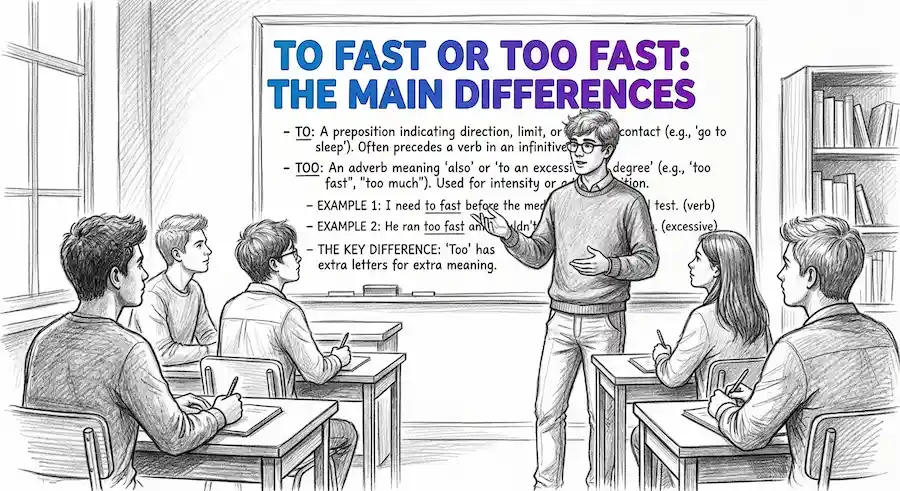
To Fast or Too Fast: The Main Differences
This comparison makes the distinction easier to remember.
| Feature | To fast | Too fast |
| Meaning | To abstain from food | Excessively quickly |
| Grammatical function | Infinitive verb phrase | Expression describing excessive speed or pace |
| Common context | Fasting, religious observance, medical instructions | Driving, speaking, reading, movement, progress |
| Example | She decided to fast. | She is walking too fast. |
| Main clue | Fast names an action | Too expresses excess |
Compare these three sentences:
I need to fast.
This means that I need to abstain from food for a period of time.
I am going too fast.
This means that I am moving or progressing at an excessive speed.
I am going to fast.
This sentence can also be grammatically correct. It can mean that I intend to abstain from food. In this construction, going to introduces a future intention, and fast is the main verb.
The words may sound alike, but their grammatical structures and meanings differ. Reading the entire sentence is more reliable than choosing a spelling based on pronunciation alone.
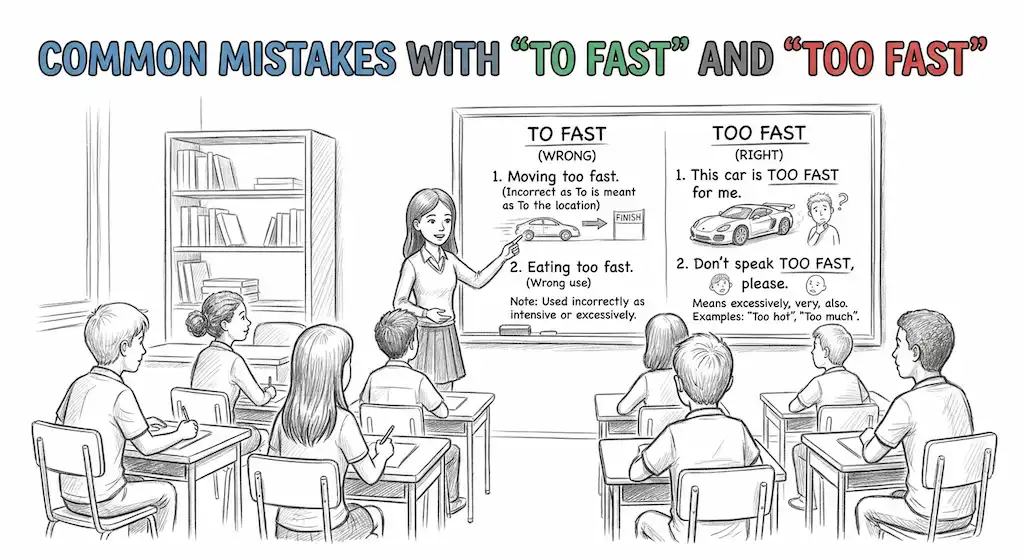
Common Mistakes With “To Fast” and “Too Fast”
Understanding the rule is helpful, but comparing incorrect sentences with their corrections makes it easier to apply.
Mistake One: Using “To Fast” for Excessive Speed
Incorrect: The driver was going to fast.
Correct: The driver was going too fast.
The sentence describes the driver’s speed. Since the intended meaning is excessive speed, too is necessary.
Mistake Two: Assuming “To Fast” Is Always Wrong
Incorrect rule: Never write “to fast.”
Correct rule: Use to fast when fast means to abstain from food.
For example, “She chose to fast during the observance” is grammatically correct. The phrase would be inappropriate only if the writer intended to describe excessive speed.
Mistake Three: Relying Only on Pronunciation
Incorrect: You are speaking to fast.
Correct: You are speaking too fast.
The words to and too sound alike in many varieties of English. Pronunciation alone cannot reliably tell you which spelling to use.
Instead, identify the meaning of the sentence before choosing the word.
Mistake Four: Confusing “Fast” With “Too Fast”
Incorrect interpretation: “She runs fast” always means she runs too quickly.
Correct interpretation: “She runs fast” describes speed, while “She runs too fast for me to keep up” identifies a problem caused by the speed.
The distinction matters because too adds a meaning that fast does not express by itself.
Mistake Five: Confusing “To,” “Too,” and “Two”
These three words sound alike in many accents, but their meanings differ.
- To commonly introduces an infinitive verb or indicates direction: I want to learn.
- Too means excessively or also: The music is too loud. I want to come, too.
- Two represents the number 2: I have two books.
For more examples of the word too, see the Cambridge Dictionary’s entry for too.
Easy Ways to Remember the Difference
You do not need to memorize a long grammar explanation every time you write. Use these simple checks instead.
Remember That “Too” Can Mean Excess
The extra letter o in too can remind you of something extra.
For example, “The car is going too fast” means the speed is greater than is appropriate for the situation.
Remember this association:
Too fast = excessively fast.
This is a memory aid, not a complete definition of every use of too, because too can also mean “also.”
Ask Whether “Fast” Names an Action
If fast means abstaining from food, to fast can be correct.
Examples:
- She plans to fast tomorrow.
- He decided to fast during the observance.
If fast describes how quickly someone moves, speaks, or works, use too fast when the speed is excessive.
Examples:
- You are driving too fast.
- The speaker is talking too fast.
Read the Complete Sentence
Sometimes a phrase is unclear when you see it on its own. Reading the whole sentence often reveals the intended meaning.
Compare:
- I am going to fast tomorrow.
- I am going too fast on this road.
The first sentence describes an intention to fast. The second describes excessive speed. Although the expressions sound similar, their grammatical structures and meanings are different.
Practice Quiz: To Fast or Too Fast?
Choose the correct expression for each sentence. Think about the meaning before checking the answers.
- The car is moving _____ on the wet road.
- She decided _____ during the observance.
- You are speaking _____ for me to follow.
- They plan _____ tomorrow.
- I typed the message _____ and missed a word.
- The patient was instructed _____ before the test.
- He is walking _____ for the group to keep up.
- I want _____ for a specific period.
Answers and Explanations
- Too fast. The sentence describes excessive driving speed.
- To fast. The phrase describes the action of abstaining from food.
- Too fast. The speaking rate is excessive for the listener.
- To fast. The sentence describes a planned action.
- Too fast. The typing speed caused the writer to miss a word.
- To fast. The infinitive introduces the action of fasting.
- Too fast. The walking speed is too high for the group to keep up.
- To fast. The speaker wants to perform the action of fasting.
If you missed any answers, review the distinction between speed and the action of fasting. The purpose of the exercise is to help you recognize meaning rather than simply memorize spelling.
For more grammar practice, explore Articles in English and Predicate in English Grammar on GillGrammar.com. These lessons cover other parts of English sentence structure and word usage.
Related Grammar Lessons
Learning to distinguish similar sounding words can help you become a more confident writer. The same habit applies when you compare other commonly confused expressions.
For example, read Did You Have or Did You Had to understand the correct verb form in questions about the past. You can also review No Difference vs. No Different to learn why similar looking expressions do not always work in the same grammatical contexts.
Another useful comparison is Even Though, which explains the difference between the standard two word expression and an incorrect combined spelling. Use these lessons as additional practice when checking word choice and sentence structure.
Conclusion
Choosing between to fast and too fast becomes easier when you focus on the meaning of the sentence. Use too fast to describe excessive speed or a pace that is unsuitable for the situation, as in “The car is moving too fast” or “The teacher is speaking too fast.” Use to fast when fast is a verb meaning to abstain from food, as in “She decided to fast.”
The most useful habit is to check what fast means before choosing the spelling. If you are describing movement, speaking, reading, or progress, ask whether the speed is excessive. If you are describing an action involving abstaining from food, the infinitive to fast may be correct. Remember that too can express excess, while to commonly introduces an infinitive verb. With this simple distinction, you can avoid a frequent English writing mistake and communicate your meaning more clearly.
Frequently Asked Questions
Is “to fast” or “too fast” correct?
Both expressions are correct when used with their intended meanings. Too fast describes excessive speed, as in “You are driving too fast.” To fast uses fast as a verb meaning to abstain from food, as in “She decided to fast.” The correct expression depends on the sentence.
What does “too fast” mean?
Too fast means moving, speaking, or progressing more quickly than is appropriate for a particular situation. For example, “The teacher is speaking too fast” suggests that the listener cannot comfortably follow the explanation. The word too communicates excess, not merely high speed.
What does “to fast” mean?
To fast means to abstain from eating food for a period of time. It is the infinitive form of the verb fast. For example, “They plan to fast” means they intend to abstain from food. The phrase may appear in religious contexts or in medical instructions.
Is “I am going to fast” grammatically correct?
Yes. “I am going to fast” can mean that you intend to abstain from food. In this sentence, going to introduces a future intention, and fast is the main verb. However, if you mean that you are moving excessively quickly, write “I am going too fast.”
Why do “to” and “too” sound the same?
In many varieties of English, to and too are pronounced alike. They are homophones, words that share a pronunciation but have different spellings and meanings. Because the sound does not reliably distinguish them, use the sentence’s meaning and grammatical structure to select the correct word.
How can I remember the difference between “to” and “too”?
Remember that too often expresses excess, as in “too fast” or “too loud.” The word to commonly introduces an infinitive verb, as in “to read,” “to learn,” and “to fast.” The extra o in too can serve as a reminder of something extra or excessive.
Is “You are driving to fast” correct?
No, not if you mean that the driver is moving at an excessive speed. The correct sentence is “You are driving too fast.” Here, too expresses excess, and fast describes the driving speed. If the intended meaning is to abstain from food, the phrase to fast can be correct in a different sentence.
Can “too fast” describe speaking or learning?
Yes. Too fast can describe speaking, reading, typing, learning, or progress when the rate is excessive for the circumstances. For example, “The lesson moved too fast for beginners” means that the pace made it difficult for beginners to follow. The phrase is not limited to vehicles or physical movement.
What is the difference between “fast” and “too fast”?
Fast describes a high speed or rate without necessarily suggesting a problem. Too fast describes a speed or rate that exceeds what is appropriate. “She runs fast” is a neutral statement, while “She runs too fast for me to keep up” identifies a difficulty caused by the speed.
Which phrase should I use in formal writing?
Choose the expression that matches your intended meaning. Use too fast when describing excessive speed and to fast when referring to the action of abstaining from food. The same distinction applies in formal and informal American English. Correct word choice helps make your writing precise and easy to understand.

”Christopher Lane is a passionate teacher and the creator behind GillGrammar. With a strong commitment to education and linguistic clarity, Christopher helps readers conquer English grammar hurdles, distinguish between confusing words, and build stronger writing skills every day.
