
Predicate in English Grammar helps explain what the subject does, is, or experiences in a sentence. Even when a sentence contains the right words, its meaning can be unclear if its structure is incomplete. Learning predicate meaning, types, and rules helps you build clear and meaningful sentences. This guide explains simple predicates, complete predicates, compound predicates, and linking verbs with easy examples. You will also learn common mistakes and practice exercises to strengthen your grammar skills.
What Is a Predicate in English Grammar?
A predicate is the part of a sentence that tells us something about the subject. It contains a verb and may include other words that complete or explain the subject’s action, condition, identity, or experience.
Consider this example:
The young student reads a book every evening.
- Subject: The young student
- Predicate: reads a book every evening
The subject tells us who the sentence is about. The predicate explains what the student does and adds information about the action.
Here is another example:
The classroom is quiet.
The subject is The classroom, and the predicate is is quiet. This predicate describes the classroom rather than showing a physical action.
A predicate can be short or long. In the sentence Birds sing, the predicate is just one word. In The birds sing beautiful songs in the garden, the complete predicate includes the verb and the additional information connected to it.
What Are the Main Types of Predicates?
English grammar lessons commonly distinguish three useful types: simple predicates, complete predicates, and compound predicates. Each type describes a different feature of sentence structure.
Simple Predicate
A simple predicate is the main verb or verb phrase that tells what the subject does or what happens to it. It includes helping verbs when they form part of the verb phrase.
Examples:
- The baby smiled.
- Our teacher is explaining the lesson.
- Maya has finished her homework.
- The team will practice tomorrow.
- The children have been playing outside.
In the first sentence, smiled is the simple predicate. In the second, is explaining is the simple predicate because is helps form the verb phrase.
Notice that a simple predicate does not have to be a single word. Helping verbs such as is, have, will, and can may appear with the main verb.
Complete Predicate
A complete predicate contains the simple predicate and the other words that belong to it, such as objects, complements, and modifiers.
For example:
The little puppy slept beside the fireplace.
The subject is The little puppy. The complete predicate is slept beside the fireplace, while the simple predicate is slept.
Here are more examples:
- My sister bought a new backpack yesterday.
- The students completed their science projects before lunch.
- A bright rainbow appeared above the quiet village.
- Our neighbors painted the fence last weekend.
- The friendly teacher explained the difficult question patiently.
The additional words provide useful information about the action. They may explain what happened, where it happened, when it happened, or how it happened.
Compound Predicate
A compound predicate contains two or more verbs or verb phrases that share the same subject. It allows you to express related actions without repeating the subject.
Examples:
- Olivia opened the window and welcomed the breeze.
- The puppy chased a butterfly and rolled in the grass.
- My father cooked dinner and washed the dishes.
- The children laughed, danced, and sang.
- Our teacher introduced the topic and answered questions.
In the third example, My father is the subject of both actions. The compound predicate combines cooked dinner and washed the dishes.
A compound predicate can make writing smoother, but separate sentences may be better when the actions need special emphasis.
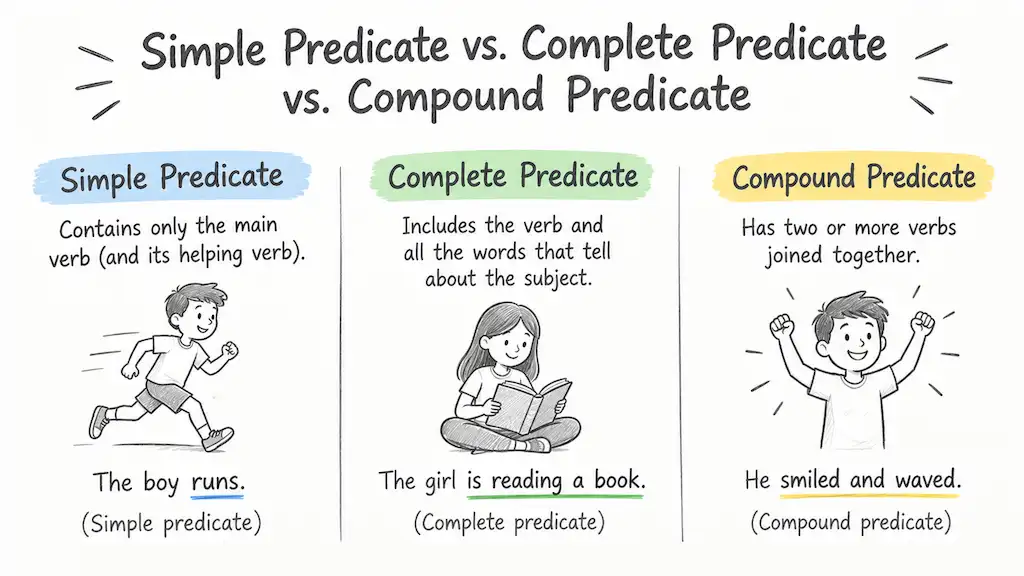
Simple Predicate vs. Complete Predicate vs. Compound Predicate
These terms are related, but they do not mean exactly the same thing.
| Predicate type | What it identifies | Example |
|---|---|---|
| Simple predicate | The main verb or verb phrase | Birds are singing. |
| Complete predicate | The verb and all related words in the predicate | Birds are singing in the trees. |
| Compound predicate | Multiple verbs or verb phrases sharing one subject | Birds sing and build nests. |
A compound predicate can also be a complete predicate. For example, in The birds sing and build nests in spring, the complete predicate is sing and build nests in spring. Its two main actions make it compound.
For a more detailed explanation of verbs, read verbs in English grammar.
How Linking Verbs Form Predicates
Not every predicate describes an action. Some predicates use linking verbs to connect the subject with a description, condition, or identity.
Common linking verbs include forms of be, such as am, is, are, was, and were. Other examples include seem, become, appear, and certain uses of look, feel, and smell.
Consider these sentences:
- The soup smells delicious.
- Her idea seems interesting.
- My uncle is a talented musician.
- The classroom became quiet.
- The weather looks pleasant today.
Each bold phrase is a complete predicate. The linking verb connects the subject to information that describes or identifies it.
Be careful with verbs that can perform different jobs. In The flower smells sweet, smells links the flower to a description. In The chef smells the flower, smells expresses an action. The role depends on how the verb functions in the sentence.
How to Find the Predicate in a Sentence
You can identify a predicate by following a few practical steps. This method works for many basic sentences and helps you analyze longer examples.
Step 1: Find the Verb
Look for the word or words expressing an action, condition, or state.
Example: The children are playing outside.
The verb phrase is are playing. Are is a helping verb, and playing is the main verb.
Step 2: Identify the Subject
Ask who or what performs the action, experiences the condition, or is being described.
Who are playing? The children.
Therefore, The children is the subject.
Step 3: Identify the Complete Predicate
Find the verb and the other words that belong to the predicate.
In The children are playing outside, the complete predicate is are playing outside.
Step 4: Check the Meaning
Read the sentence again to make sure the subject and predicate work together.
For example:
The tall boy in our class won the spelling contest yesterday.
The complete subject is The tall boy in our class. The complete predicate is won the spelling contest yesterday.
Although the sentence contains several words before the verb, the central action is still won. Recognizing the main verb makes the sentence easier to analyze.
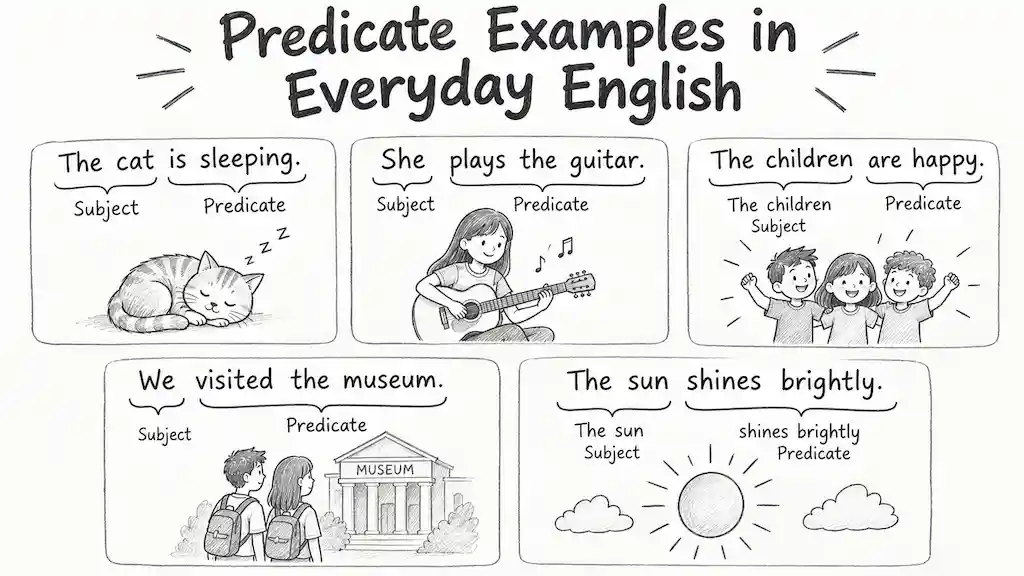
Predicate Examples in Everyday English
These examples show how predicates work in school, at home, and in everyday communication.
Simple Predicate Examples
- The phone rang.
- Our team won.
- Emma is reading.
- The horse galloped.
- My brother has arrived.
- Winter has ended.
- Dad will return.
- Maya can swim.
The bold words identify each simple predicate, including the helping verbs that belong to the verb phrase.
Complete Predicate Examples
- The little puppy slept beside the fireplace.
- Our family visited the national park last weekend.
- The teacher explained the lesson with clear examples.
- A small bird built its nest beneath the porch.
- The basketball players practiced on the outdoor court.
- Heavy rain washed the dust from the sidewalks.
- My sister is drawing a colorful butterfly.
- The cashier helped an older customer.
Each complete predicate includes the verb and the additional words that tell us more about the subject.
Compound Predicate Examples
- Daniel finished his assignment and submitted it online.
- The wind shook the branches and scattered the leaves.
- My grandmother planted tomatoes and watered the garden.
- The bus stopped at the corner and picked up passengers.
- The singer practiced every morning and performed confidently.
- The children read stories, shared ideas, and asked questions.
Each sentence has one shared subject and multiple actions. This structure helps writers connect related ideas without unnecessary repetition.
Predicates That Describe the Subject
- The flowers look fresh this morning.
- The children seem excited.
- The road remained slippery after the storm.
- My favorite subject is English.
- His explanation was helpful to everyone.
- The countryside appeared peaceful after the rain.
These examples demonstrate that predicates can identify, describe, or explain a subject rather than simply report an action.
Predicate Rules and Common Mistakes
Understanding the basic rules helps you avoid incomplete sentences and incorrect sentence analysis.
Mistake 1: Confusing the Subject With the Predicate
The subject tells who or what the sentence is about. The predicate tells something about that subject.
Incorrect identification:
The young girl is the predicate in The young girl danced gracefully.
Correct identification:
- Subject: The young girl
- Predicate: danced gracefully
Mistake 2: Calling Only the Verb the Complete Predicate
A verb may be the entire predicate in a short sentence, but longer sentences often contain additional words in the complete predicate.
Example: The children played happily in the park.
Simple predicate: played
Complete predicate: played happily in the park
The distinction matters when a grammar exercise asks for the complete predicate rather than the main verb.
Mistake 3: Confusing a Compound Predicate With a Compound Sentence
A compound predicate contains multiple actions sharing one subject. A compound sentence contains at least two independent clauses.
| Sentence | Correct identification |
|---|---|
| Mia cooked dinner and cleaned the kitchen. | Compound predicate |
| Mia cooked dinner, and Noah cleaned the kitchen. | Compound sentence |
| The dog barked and jumped excitedly. | Compound predicate |
| The dog barked, and the cat ran away. | Compound sentence |
In the first sentence, Mia performs both actions. In the second, Mia and Noah have separate subject and predicate relationships.
Mistake 4: Using an Incomplete Thought
Some sentences need more information to express the intended meaning.
Incomplete: The student placed.
Complete: The student placed the books on the shelf.
The verb placed usually needs information about what was placed. Adding the books on the shelf completes the intended idea.
However, not every short sentence is incomplete. The baby slept is a complete sentence because slept can express a complete idea without an object.
Mistake 5: Forgetting Subject Verb Agreement
The verb in the predicate must agree with the subject in person and number.
Incorrect: The students walks to school.
Correct: The students walk to school.
Also correct: The student walks to school.
The subject, not a nearby noun, determines the appropriate verb form. Review subject and sentence structure for additional guidance.
Predicates in Questions and Commands
The predicate does not always appear in the same word order as it does in an ordinary statement.
In questions, helping verbs may come before the subject.
Examples:
- Did you finish your homework?
- Can the baby walk independently?
- Have the students completed the assignment?
The helping verb appears before the subject in these questions, but the predicate still contains the verb phrase and its related words.
Commands work a little differently because the subject is often understood to be you.
Examples:
- Close the door carefully.
- Read the instructions before beginning.
- Place your notebook on the desk.
In each command, the implied subject is you. The predicate expresses the requested action.
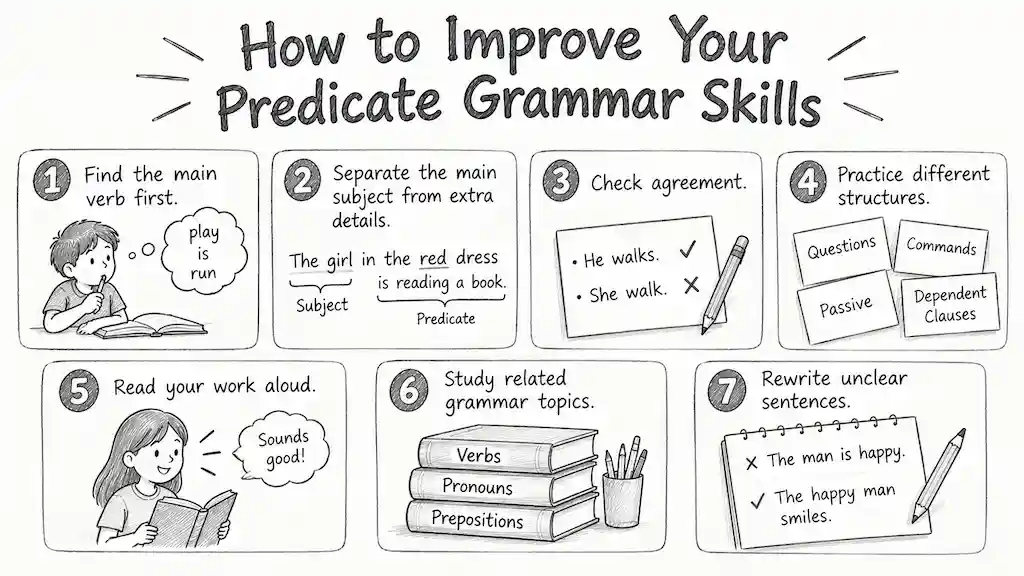
How to Improve Your Predicate Grammar Skills
Regular practice can make sentence analysis easier. Try these techniques when reading, writing, or studying English.
- Find the main verb first. Identify the action or state before deciding which words belong to the predicate.
- Separate the subject from extra details. Descriptive phrases can make the subject longer without changing its central meaning.
- Look for helping verbs. In She has been studying, the complete verb phrase is has been studying.
- Check the full predicate. Include objects, complements, and modifiers that belong to the predicate.
- Recognize shared subjects. When one subject performs several actions, check whether the sentence has a compound predicate.
- Review verb agreement. Make sure the verb matches the subject.
- Read your sentence aloud. This can help you notice missing words or unclear phrasing.
- Practice with real sentences. Use books, school assignments, emails, and everyday conversations.
For further practice with sentence connections, explore conjunctions and their uses. You can also review prepositions and their functions to understand how extra details fit into a sentence.
Predicate Practice: Test Your Understanding
Identify the requested predicate in each sentence before checking the answers.
- The puppy barked loudly.
- Sarah has finished her project.
- The children sang and danced.
- Our new teacher is very friendly.
- Did Mark complete the assignment?
- The bird flew across the garden.
- Close the window gently.
- My brother washed the car and cleaned the garage.
Answers and Explanations
- barked loudly is the complete predicate. The simple predicate is barked.
- has finished her project is the complete predicate. The simple predicate is has finished.
- sang and danced is the compound predicate. The children share both actions.
- is very friendly is the complete predicate. The linking verb is describes the subject.
- did complete the assignment identifies the verb phrase and its related words, although the question places did before the subject. The complete predicate includes did complete the assignment.
- flew across the garden is the complete predicate. Flew is the simple predicate.
- Close the window gently is the predicate of the command. Its understood subject is you.
- washed the car and cleaned the garage is the compound predicate because both actions share the subject My brother.
When analyzing a question or command, remember that word order can change. Focus on the verb, its relationship to the subject, and the words that complete the intended meaning.
Conclusion
A predicate is a central part of sentence structure because it tells readers what the subject does, experiences, or is. Recognizing predicates helps you understand how sentences work and express ideas more clearly. The simple predicate identifies the main verb or verb phrase, while the complete predicate includes the related words that explain it. A compound predicate connects multiple actions that share one subject.
Linking verbs also form predicates by connecting subjects with descriptions or identities. In questions, helping verbs may appear before the subject, and commands often use an understood subject. These patterns become easier to recognize when you practice with different sentence types.
Start with short sentences, identify the subject and verb, and then find the complete predicate. As you become more comfortable, move on to longer sentences and compound structures. Consistent practice will strengthen your grammar knowledge and help you write clearer, more accurate English.
Frequently Asked Questions About Predicates
What is a predicate in grammar?
A predicate is the part of a sentence that tells something about the subject. It contains a verb and may include objects, complements, and modifiers. In The dog barked loudly, the predicate is barked loudly because it explains what the dog did.
What are the three main types of predicates?
The three commonly taught types are simple predicates, complete predicates, and compound predicates. A simple predicate contains the main verb or verb phrase. A complete predicate includes the verb and its related words. A compound predicate contains multiple verbs or verb phrases that share a subject.
What is an example of a simple predicate?
In The baby is sleeping peacefully, the simple predicate is is sleeping. It includes the helping verb is and the main verb sleeping. The word peacefully belongs to the complete predicate because it adds information about how the baby is sleeping.
What is an example of a complete predicate?
In My brother played basketball after school, the complete predicate is played basketball after school. It includes the verb played, the object basketball, and the time information after school. The simple predicate is played.
What is a compound predicate?
A compound predicate contains two or more verbs or verb phrases that share the same subject. In Lily opened the door and greeted her friends, the compound predicate is opened the door and greeted her friends. Lily performs both actions.
How do you find the predicate in a sentence?
First, find the main verb or verb phrase. Then identify the subject by asking who or what performs the action or experiences the condition. Finally, identify the verb and all the words that belong to the predicate. In The bird sang in the tree, the predicate is sang in the tree.
Can a predicate be one word?
Yes. In Birds fly, the predicate is fly. That single word is both the simple predicate and the complete predicate because no additional words are needed to complete the sentence.
Can a sentence have more than one predicate?
Yes. A sentence can contain a compound predicate, in which multiple verbs or verb phrases share one subject. A sentence with multiple clauses can also contain separate predicates for different subjects. The correct analysis depends on the sentence structure.
What is the difference between a predicate and a verb?
A verb is a word or part of a verb phrase that expresses an action, state, or condition. A predicate is the larger sentence part built around the verb. In The children played outside, played is the simple predicate, while played outside is the complete predicate.
Are predicates the same in American and British English?
The basic grammatical concept of a predicate is the same in American and British English. Both varieties use predicates to express information about subjects. Some vocabulary, spelling, and usage conventions differ between the varieties, but the basic distinction between a subject and a predicate remains consistent.


1 thought on “Predicate in English Grammar: Meaning, Types, Rules & Examples”