
Choosing between adapter vs adaptor can be confusing because both spellings are correct, yet writers often wonder which one to use. Picking the wrong form for your audience or a product name can make otherwise clear writing look inconsistent. The good news is that the two words generally share the same meaning. This guide explains their definitions, regional preferences, everyday uses, and the easiest way to choose the right spelling.
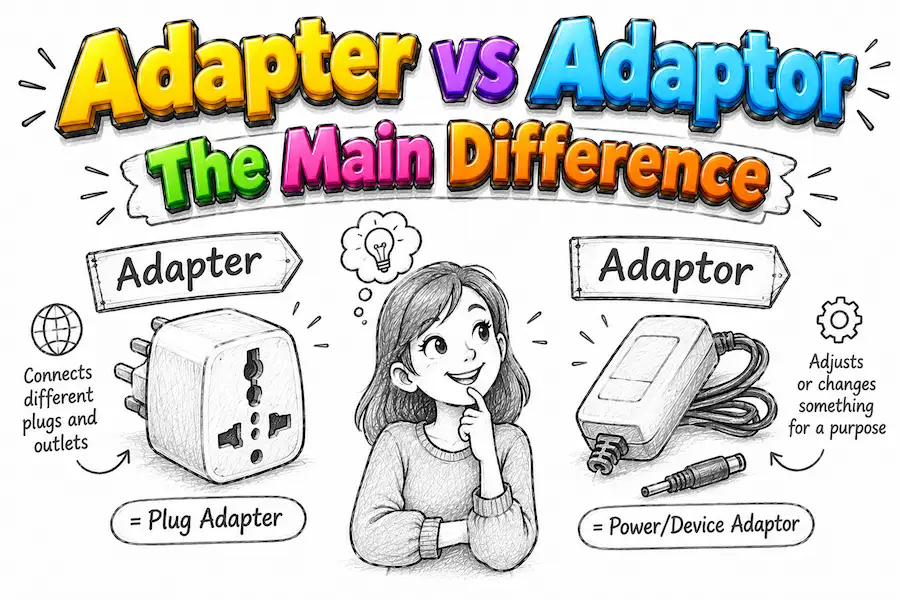
Adapter vs Adaptor: The Main Difference
Adapter and adaptor are alternative spellings of the same noun. Both can describe a device that connects two pieces of equipment or a person who changes existing material for a different purpose.
The main difference is spelling preference, not a universal difference in meaning.
For example:
- I need a power adapter for my laptop.
- I need a power adaptor for my laptop.
- The photographer bought a lens adapter.
- The photographer bought a lens adaptor.
Each sentence is understandable, and both spellings can be correct. However, your audience, industry, or organization’s preferred style may influence which version you should choose.
Which Spelling Should You Use?
For general American English writing, adapter is usually the safest choice. It is familiar in everyday language, consumer electronics, computing, and product descriptions.
Adaptor is also an accepted spelling. You may encounter it in British English, technical documents, and established product names. British writers also use adapter, so the regional distinction is a preference rather than an absolute rule.
Here is a simple guide:
| Situation | Recommended approach |
|---|---|
| General American English | Prefer adapter |
| British English | Check local usage and house style |
| Technology and electronics | Adapter is a common default |
| Official product name | Preserve the manufacturer’s spelling |
| Technical documentation | Follow the relevant terminology |
| Existing document | Maintain consistent spelling |
The practical rule is straightforward: choose adapter for ordinary American English unless a recognized convention gives you a reason to use adaptor.
What Does Adapter Mean?
An adapter is something that allows two things to connect, fit together, or work with each other. The word commonly describes a physical device, although it can also refer to a person who adapts existing creative material.
The noun comes from the verb adapt, which means to change or adjust something for a particular purpose.
Adapter as a Device
A physical adapter helps equipment work together when their connections or designs differ.
Common examples include:
- Power adapter: Supplies electrical power to a device in the required form.
- USB adapter: Allows devices or connectors with different USB connections to work together when compatible.
- Network adapter: Enables a computer or another device to connect to a network.
- Lens adapter: Allows a camera lens to work with a camera body that uses a different mount, when compatible.
- Audio adapter: Connects audio equipment with different connector types.
- Travel adapter: Allows a plug to fit a different socket type.
For example:
My laptop needs a power adapter before I can use it.
In this sentence, adapter refers to a physical component, not an action or a person.
Keep in mind that an adapter does not automatically convert electricity, change every signal, or make incompatible equipment fully compatible. Its function depends on the particular device.
Adapter as a Person
The word can also describe someone who changes a book, play, or other creative work for a new format.
For example:
The adapter changed the novel into a script for the stage.
Here, the noun identifies a person who adapts existing material. Words such as screenwriter or adaptation writer may be more specific in some situations, but adapter is an established usage.
This example also shows why it is inaccurate to claim that adapter always means a device.
What Does Adaptor Mean?
Adaptor has the same basic meaning as adapter. It can refer to a connecting device or a person who adapts material.
For example:
- I bought a travel adaptor for my trip.
- The adaptor connects the two pieces of equipment.
- The camera adaptor allows the lens to fit the camera body.
- The adaptor prepared the story for a television production.
These examples use adaptor in the same general senses as adapter.
The spelling may be more familiar in some British English contexts, but it is not limited to Britain. Nor is it automatically outdated, informal, or grammatically incorrect.
The most useful distinction is between an accepted spelling and a preferred spelling. Both forms are accepted, while one may be more appropriate for a particular audience or organization.
For a more detailed definition, consult the Oxford Learner’s Dictionaries entry for adapter, which also recognizes adaptor as an alternative.
Is Adapter or Adaptor Correct in American English?
Both spellings are valid, but adapter is generally the more familiar choice in American English.
American writers commonly use expressions such as:
- Power adapter
- USB adapter
- Wireless adapter
- HDMI adapter
- Travel adapter
Consider this example:
Please bring a compatible power adapter for your laptop.
This is a natural choice for an American audience.
Nevertheless, finding adaptor in an American document does not automatically mean the writer made a spelling mistake. A manufacturer may use that spelling in an official product name, or a technical organization may follow a particular convention.
When writing for an American audience, use adapter by default and preserve adaptor when the context requires it.
The Cambridge Dictionary’s adapter entry also lists adaptor as an alternative spelling and explains the word’s device and writer related meanings.
Is Adaptor Correct in British English?
Yes. Adaptor is an established spelling in British English, especially in references to electrical and connecting devices. However, adapter is also used in Britain.
For example:
I need a travel adaptor for my holiday.
A British publication may prefer this spelling, while another may use:
I need a travel adapter for my holiday.
Neither sentence is inherently incorrect. The preferred form depends on the publication, product terminology, and established usage.
This is why writers should avoid rigid rules such as “adapter is American and adaptor is British.” That statement oversimplifies real English usage.
If you are writing for a British website, check its style guide or examine the spelling used consistently in its existing content. The same approach works for Australian, Canadian, and international publications.
Adapter vs Adaptor in Everyday Situations
Understanding the difference becomes easier when you see the spellings in familiar contexts.
Power Adapter vs Power Adaptor
Both expressions can describe a device that supplies power to compatible equipment.
- American style: I forgot to pack my laptop power adapter.
- Alternative spelling: I forgot to pack my laptop power adaptor.
The spelling does not, by itself, tell you how the device works. Check the manufacturer’s specifications to understand its electrical output and compatibility.
Travel Adapter vs Travel Adaptor
Both forms refer to equipment used to connect a plug to a differently shaped socket.
- We bought a travel adapter before leaving the United States.
- We bought a travel adaptor before leaving the United States.
The main consideration is audience and convention. For an American travel guide, travel adapter is usually the natural choice.
One important distinction: a plug adapter does not necessarily convert voltage or frequency. Travelers should check whether their equipment supports the destination’s electrical supply before plugging it in.
USB Adapter vs USB Adaptor
Both spellings can describe a device that connects compatible USB equipment through different connector types.
For example:
I used a USB adapter to connect my keyboard to the tablet.
In general American technology writing, USB adapter is the more familiar choice. However, always check the exact product specifications rather than assuming every adapter supports every device.
Lens Adapter vs Lens Adaptor
In photography, an adapter may connect a lens mount to a camera body with a different mount.
For example:
The photographer used a lens adapter with the new camera.
Both lens adapter and lens adaptor can communicate this idea. Compatibility depends on the lens, camera, adapter design, and supported functions.
These examples demonstrate that the spelling choice generally does not change the basic meaning.
Do Adapter and Adaptor Have Different Meanings?
In ordinary usage, adapter and adaptor generally mean the same thing. Both can describe a connecting device or someone who adapts material.
A common mistake is to invent a strict rule that adapter refers only to people while adaptor refers only to devices. That distinction is not a dependable general rule.
For example, Oxford lists adapter for both a device and a person who changes a creative work for another format. The alternative spelling adaptor is also recognized.
You can verify these meanings through the Collins Dictionary’s adapter definition.
Specialized terminology can sometimes create a distinction within a particular field. If an engineering standard, manufacturer, or organization defines a term in a specific way, follow that source. Do not turn a local convention into a universal English rule.

Common Mistakes to Avoid
Mistake 1: Calling Adaptor Incorrect
Incorrect advice: “Always use adapter because adaptor is wrong.”
Better advice: Both are accepted spellings, although adapter is generally the more practical default for American English.
Mistake 2: Assuming Each Spelling Has a Separate Meaning
There is no reliable universal rule that assigns devices to one spelling and people to the other. Read the context instead of guessing the meaning from the final letter.
Mistake 3: Treating Regional Preferences as Absolute Rules
American English often favors adapter, and British usage includes adaptor. However, both spellings appear across English varieties. Use regional preference as a guide, not an unbreakable law.
Mistake 4: Changing an Official Product Name
Suppose a manufacturer names a product “Power Adaptor.” If you are referring to that exact product, preserve its official name rather than silently changing it to “Power Adapter.”
This approach is especially important in product descriptions, manuals, specifications, and technical support documents.
Mistake 5: Switching Spellings Without a Reason
A document that uses adapter in one section and adaptor in another may look poorly edited. Choose one spelling for general use and apply it consistently, unless you are quoting an official name or discussing the difference itself.
For more practical writing guidance, explore GillGrammar’s lessons on English grammar rules and setup vs set up. These topics also demonstrate why context matters when choosing between similar forms.
How to Choose the Correct Spelling
Use this short decision process whenever you are unsure.
- Identify your audience. If you are writing for American readers, start with adapter.
- Check the subject. In everyday technology writing, adapter is a familiar default.
- Look for an established term. Follow the spelling in an official product name, technical specification, or recognized style guide.
- Keep your writing consistent. Do not alternate between the two forms without a clear reason.
- Check a dictionary if needed. A reliable dictionary can confirm the meaning and recognize alternative spellings.
This process is more useful than memorizing an artificial rule that one spelling is always correct and the other is always wrong.
It also helps you make better decisions in professional writing, product descriptions, school assignments, and educational content.
Practice Quiz: Adapter or Adaptor?
Choose the spelling that best fits each sentence. Unless a specific convention is stated, both forms may be acceptable.
1. I need a power ______ for my laptop.
Answer: Adapter or adaptor.
Both are accepted. For general American English, adapter is the usual choice.
2. The computer’s wireless ______ is not working.
Answer: Adapter or adaptor.
Both spellings can be used, although wireless adapter is a familiar term in American technology writing.
3. She bought a travel ______ before her international trip.
Answer: Adapter or adaptor.
Both forms are correct. Choose the spelling that matches your audience and editorial style.
4. The photographer purchased a lens ______.
Answer: Adapter or adaptor.
Both can describe a component that connects a lens to a compatible camera body.
5. Which spelling should you generally choose for an American audience?
Answer: Adapter.
It is the more familiar default in general American English and many technology related contexts.
6. Is adaptor always incorrect?
Answer: No.
Adaptor is an accepted spelling. Its suitability depends on the context and the preferred convention.
7. Should you change an official product name from adaptor to adapter?
Answer: Usually, no.
Preserve the manufacturer’s official spelling when referring to the specific product.
8. What is the main difference between adapter and adaptor?
Answer: Usually, spelling preference rather than meaning.
Both words generally refer to something or someone that adapts one thing for another purpose.
Conclusion
The choice between adapter vs adaptor is easier when you understand that both are accepted English spellings. They generally share the same meaning, whether they refer to a connecting device or someone who adapts a creative work. The main difference is the spelling preferred by a particular audience, publication, or technical organization.
For general American English, adapter is usually the safest choice. You will commonly see it in expressions such as power adapter, USB adapter, network adapter, and travel adapter. However, adaptor is also correct and appears in British English and established technical terminology.
Before making your choice, consider the intended audience, check any relevant style guide, and preserve official product names. Most importantly, avoid claiming that one spelling is universally wrong or that the two words always have different meanings. A consistent, context aware approach will help you write more clearly and accurately.
FAQs
Is adapter or adaptor the correct spelling?
Both adapter and adaptor are correct. They generally have the same meaning and can refer to a connecting device or a person who adapts material. Adapter is usually preferred for general American English, while adaptor is also common in some British and technical contexts. Follow your audience’s preferred style.
What is the difference between adapter and adaptor?
The difference is usually spelling preference rather than meaning. Both words can describe devices that connect equipment or people who adapt creative works. The spelling you choose should depend on your audience, the relevant style guide, and any established terminology.
Is adaptor wrong in American English?
No. Adaptor is a legitimate English spelling, even though adapter is generally more familiar in American English. You may encounter adaptor in product names or technical documents. When referring to a particular product or established term, preserve its recognized spelling.
Is adapter more common in American English?
Yes, adapter is generally the more familiar choice in American English, especially in technology, electronics, computing, and consumer product descriptions. If you are writing for American readers and have no specific style requirement, adapter is usually the most practical default.
Is adaptor preferred in British English?
Adaptor is an established spelling in British English, particularly for some electrical devices. However, British writers also use adapter. The preferred choice depends on the publication, context, and established terminology, so it is best to check the relevant style guide.
Do adapter and adaptor have different meanings?
Usually, no. Both spellings can refer to a device that connects equipment or a person who adapts a creative work. There is no dependable universal rule assigning one spelling to devices and the other to people. Specialized fields may have their own terminology.
Should I write power adapter or power adaptor?
Both expressions are acceptable. For an American audience, power adapter is generally the natural choice. If a manufacturer uses power adaptor as an official product name, preserve that spelling when referring to the specific product.
Is travel adapter or travel adaptor correct?
Both travel adapter and travel adaptor are correct. Travel adapter is generally the safer choice for American English, while travel adaptor is also widely recognized. The spelling does not automatically indicate whether the device converts voltage, so check its specifications before use.
Can I use adapter and adaptor in the same article?
Yes, when there is a clear reason, such as quoting official product names or explaining spelling differences. Otherwise, choose one spelling and use it consistently. For general American English content, adapter is usually the simplest choice.
How can I remember whether to use adapter or adaptor?
Remember that both spellings are valid. When writing for a general American audience, choose adapter unless a product name, technical convention, or style guide specifies otherwise. If your audience uses another English variety, check its preferred usage rather than assuming that one form is universally correct.