
Choosing between swap vs swop can be confusing because both spellings refer to exchanging something. However, they are not equally common in modern English. Using an unfamiliar spelling may distract readers, especially in professional or academic writing. The good news is that the difference is easy to understand. This guide explains their meanings, regional usage, grammatical forms, and examples so you can confidently choose the right spelling.
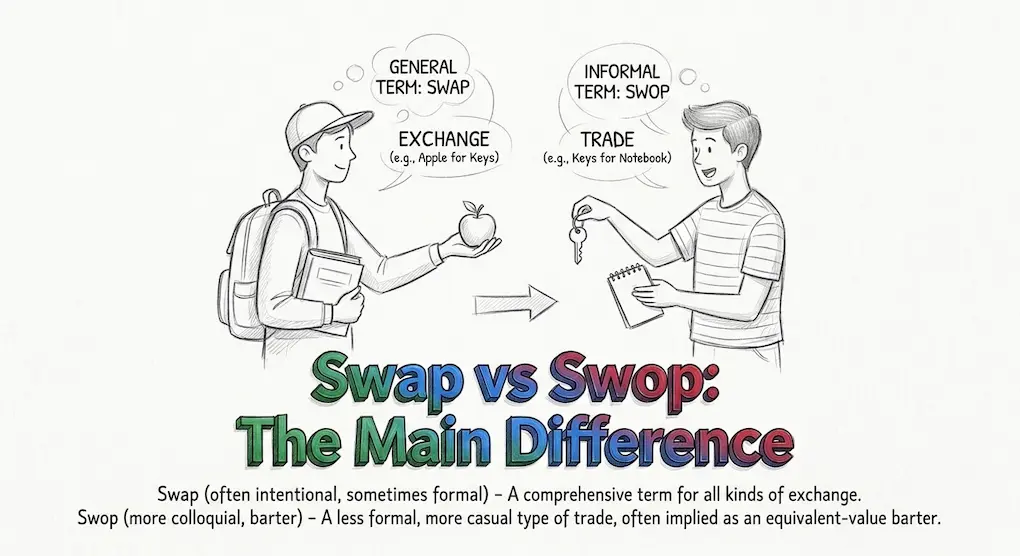
Swap vs Swop: The Main Difference
The main difference between swap and swop is their spelling preference, not their basic meaning. Both words can describe exchanging one thing for another. However, swap is the standard and widely preferred spelling, while swop is a less common alternative associated mainly with British English.
According to the Cambridge Dictionary’s definition of swap, the word means giving something and receiving something else in return. Cambridge also recognizes swop as an alternative British spelling.
Here is the basic distinction:
- Swap: The standard spelling used across American, British, and international English.
- Swop: An accepted alternative spelling, particularly associated with British English.
For example:
- We decided to swap seats during the movie.
- The children swapped their trading cards.
- They agreed to swop houses for the summer.
All three sentences communicate an exchange. However, swap is the more familiar choice for most modern readers.
The distinction is important because a word can be acceptable without being the most common or suitable option. If you are writing for an American audience or an international readership, choose swap.
What Does Swap Mean?
Swap means to exchange one thing for another. It can describe trading objects, changing positions, replacing items, or exchanging information with another person.
It works as both a verb and a noun.
Swap as a Verb
As a verb, swap describes the action of giving something and receiving something else in return.
For example:
- I want to swap my blue shirt for a black one.
- The students swapped their books after class.
- Can we swap seats?
- My brother and I often swap video games.
- The employees agreed to swap their shifts.
Notice that the word can describe exchanges involving physical objects as well as responsibilities, positions, and arrangements.
You can also use swap when two people exchange information or ideas.
For instance:
- We swapped phone numbers after the meeting.
- The teachers swapped ideas about classroom activities.
- The friends spent the evening swapping stories.
In these examples, nobody exchanges a physical object. Instead, the people share information or experiences.
Swap as a Noun
Swap can also function as a noun. In this form, it refers to an exchange or something exchanged.
Examples:
- That was a fair swap.
- We arranged a clothing swap at school.
- The two companies agreed to a currency swap.
- She suggested a book swap with her neighbor.
Compare these sentences:
Verb: We decided to swap our books.
Noun: We made a book swap.
The first sentence describes an action, while the second names the exchange.
This distinction is useful when learning how a word can perform different grammatical functions. For additional guidance, explore our article about predicates in English grammar.
What Does Swop Mean?
Swop is an alternative spelling of swap. It generally carries the same meaning, which is to exchange, trade, or switch something.
The spelling is particularly associated with British English. However, it is much less common than swap.
The Cambridge Dictionary entry for swop identifies it as mainly British usage for swap. Similarly, the Oxford Learner’s Dictionary entry for swop recognizes it as an alternative spelling with the same general exchange meaning.
Examples include:
- They decided to swop their seats.
- The children swopped their toys.
- We could swop houses during the vacation.
- She wanted to swop her red jacket for a blue one.
These sentences communicate the same basic ideas as their versions using swap.
Swop is not a separate word with a completely different definition. It is better understood as a spelling variant.
Grammatical Forms of Swop
Like swap, swop can appear in different verb forms.
| Verb form | Example |
|---|---|
| Present | I swop books with my friend. |
| Third person | She swops seats with her sister. |
| Past tense | They swopped their tickets. |
| Present participle | We are swopping ideas. |
Although these forms are possible, they are less familiar to many English readers.
For everyday writing, the standard forms of swap are usually preferable:
- Swap
- Swaps
- Swapped
- Swapping
Swap vs Swop: Comparison Table
The following table makes the difference easier to understand.
| Feature | Swap | Swop |
|---|---|---|
| Basic meaning | Exchange or trade | Exchange or trade |
| Spelling status | Standard spelling | Alternative spelling |
| American English | Normal choice | Mainly British variant |
| British English | Widely used | Recognized alternative |
| Formal writing | Preferred | Less conventional |
| Everyday conversation | Common | Less common |
| Financial terminology | Standard | Unusual |
| Technical terminology | Standard | Unusual |
The important point is that both spellings can express the same idea, but their familiarity differs.
For a broad audience, swap provides the clearest and most conventional choice.
Is Swop a British Spelling of Swap?
Yes, swop is mainly associated with British English, but calling it the British spelling of swap without qualification can create confusion.
British English does not require writers to use swop. The spelling swap is also widely used in the United Kingdom.
For example, a British writer might naturally write:
“We should swap our seats.”
Another writer might choose:
“We should swop our seats.”
Both sentences express an exchange. The difference is the spelling preference rather than the meaning.
Swap vs Swop in American English
In American English, swap is the normal spelling.
You will commonly see it in everyday expressions such as:
- Swap seats
- Swap stories
- Swap clothes
- Swap phone numbers
- Swap shifts
- Swap information
For example:
“The two students decided to swap their lunch items.”
Swop is not the usual choice in American writing. Although an American reader may understand it, the spelling can appear unfamiliar.
If you publish educational articles, business documents, emails, or general website content for American readers, use swap.
Swap vs Swop in British English
British English recognizes both spellings, but swap remains a familiar and widely used form.
Swop may appear in informal conversation, regional writing, or particular literary contexts. Nevertheless, British writers do not need to replace swap with swop.
For example:
- British English: We can swap our tickets.
- British English: We can swop our tickets.
Both communicate the same exchange.
Therefore, the safest explanation is that swop is a mainly British alternative, not an obligatory British replacement for swap.
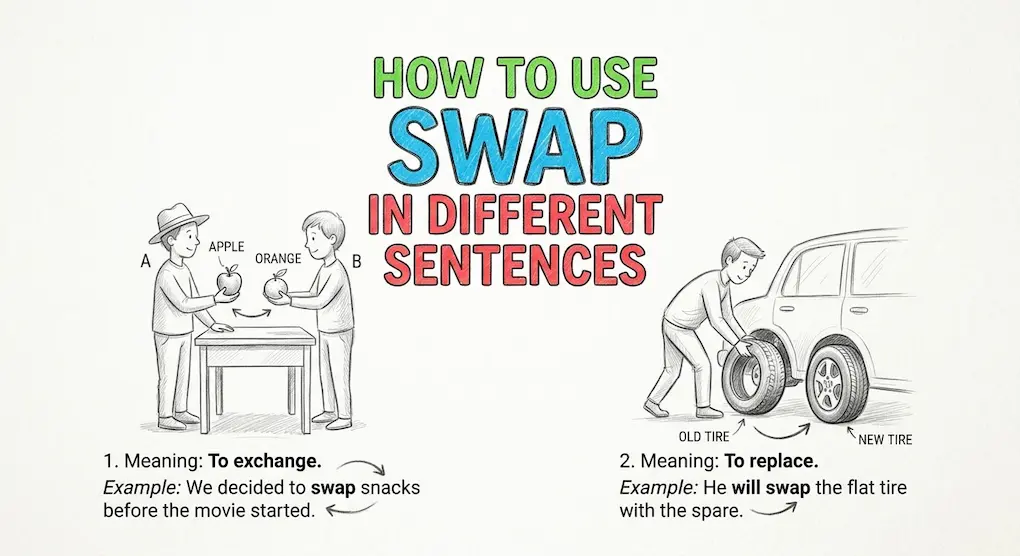
How to Use Swap in Different Sentences
Understanding sentence patterns helps you use swap correctly without confusing it with related expressions.
Swap Something for Something
Use this structure when one item is exchanged for another.
Pattern: Swap + something + for + something else.
Examples:
- I swapped my old phone for a newer model.
- She wants to swap her black shoes for white ones.
- He swapped his morning shift for an evening shift.
- They exchanged their old furniture for new pieces.
The word for introduces the replacement.
Swap Something With Someone
Use with when identifying the other person involved in the exchange.
Examples:
- I swapped books with my cousin.
- She swapped seats with her friend.
- The students swapped notes with one another.
- We swapped contact details after the event.
This construction highlights the people participating in the exchange.
Swap Places
The expression swap places means to exchange positions with another person.
Examples:
- Can we swap places? I cannot see the screen.
- The players swapped places during practice.
- My sister and I swapped seats on the bus.
It can also describe imagining another person’s situation.
For example:
“I would not swap places with him.”
This means the speaker does not want to be in that person’s situation.
Swap Stories or Ideas
Swap can describe sharing information, opinions, or experiences.
Examples:
- The friends swapped stories about their childhood.
- We swapped ideas during the discussion.
- The students swapped answers after completing the exercise.
In these sentences, swap does not mean exchanging physical objects. It means sharing something with another person.
Swap, Swapped, and Swapping: Correct Verb Forms
One common question concerns the different forms of swap.
The verb follows a regular pattern when forming its past tense and present participle.
| Form | Correct spelling | Example |
|---|---|---|
| Base form | Swap | I swap books. |
| Third person singular | Swaps | She swaps books. |
| Past tense | Swapped | We swapped books. |
| Past participle | Swapped | They have swapped books. |
| Present participle | Swapping | He is swapping books. |
Why Does Swapped Have Two Ps?
The word swap ends with a short vowel sound followed by a consonant. When adding the endings ed or ing, the final consonant is doubled.
Therefore:
- Swap becomes swapped.
- Swap becomes swapping.
The same spelling pattern appears in several other English verbs.
For example:
- Stop becomes stopped.
- Plan becomes planned.
- Shop becomes shopped.
This spelling rule helps you avoid common mistakes such as writing swaped or swaping.
For more guidance on choosing correct word forms, read our explanation of Did You Have or Did You Had.
Common Expressions With Swap
Swap appears in many everyday and specialized expressions. Learning these combinations will help you recognize the word in different situations.
Swap Seats
This means exchanging sitting positions.
Example: Could you swap seats with me?
Swap Shifts
This means exchanging work schedules.
Example: The employees agreed to swap shifts on Friday.
Swap Stories
This means sharing personal experiences or information.
Example: The two friends swapped stories during dinner.
Currency Swap
A currency swap is a financial arrangement involving the exchange of payments in different currencies.
Example: The financial institutions arranged a currency swap.
Swap Meet
In American English, a swap meet is an event where people gather to buy, sell, or exchange goods.
Example: We found some interesting antiques at the local swap meet.
Swap Files
In technology, swapping files can refer to exchanging files or replacing one file with another.
Example: The team decided to swap the outdated files.
These expressions demonstrate why swap is useful in everyday language, business, finance, and technology.
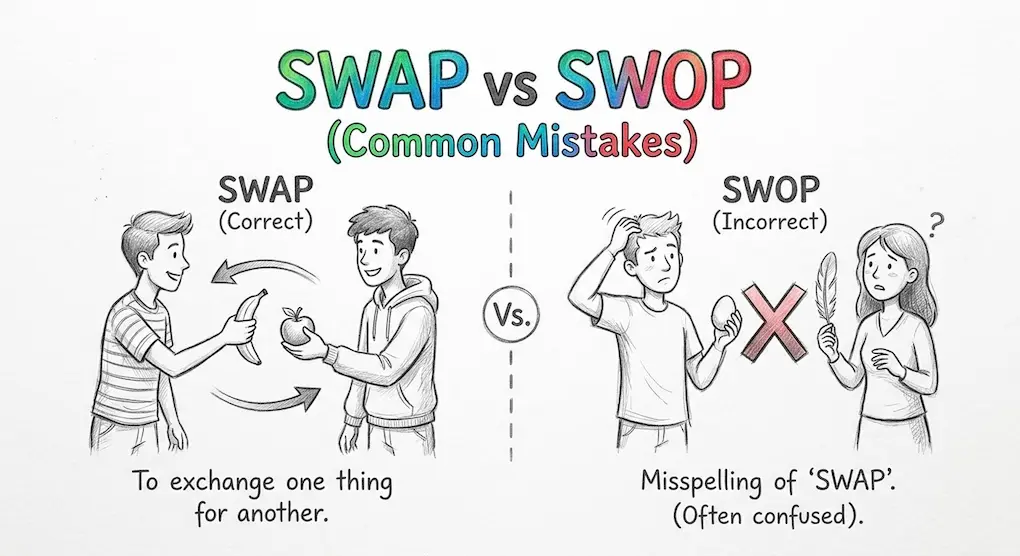
Common Mistakes When Choosing Swap or Swop
Even though the distinction is simple, writers sometimes misunderstand how the two spellings work.
Here are mistakes worth avoiding.
1. Assuming Swop Is Always Incorrect
Swop is a recognized alternative spelling. It is not automatically a spelling mistake.
However, it is much less common than swap. Therefore, choose the more familiar spelling unless a particular regional or stylistic reason supports swop.
2. Assuming Both Words Have Different Meanings
Swap and swop generally mean the same thing.
Neither spelling normally describes a different type of exchange. Their main distinction concerns spelling preference and usage.
3. Treating Swop as the Required British Form
British writers can use swap without making a spelling error.
Swop is an alternative, not a compulsory regional replacement.
4. Writing Swop in Established Technical Expressions
Technical and professional expressions normally use swap.
For example:
- Currency swap
- Interest rate swap
- Swap space
- Swap file
Using swop in these expressions would look unusual and may confuse readers.
5. Mixing Both Spellings Without a Reason
Consistency makes writing easier to read.
If you choose swap for a general article, continue using that spelling throughout the article. Only introduce swop when discussing the alternative spelling or quoting a source.
6. Confusing Swap With Switch
Swap and switch have related meanings, but they are not interchangeable in every sentence.
Swap usually emphasizes an exchange between two things or people.
Switch often means changing from one option, position, or activity to another.
Compare:
- We swapped seats.
- We switched off the television.
The first sentence describes an exchange. The second describes changing the television from an operating state to an inactive one.
For more word choice guidance, see Setup vs Set Up and Due To or Do To.
How to Remember the Correct Spelling
You do not need a complicated memory trick to distinguish swap from swop.
Remember these three simple points:
1. Swap is your default.
Use swap in everyday, professional, academic, and international writing.
2. Swop is an alternative.
Recognize swop as a valid but less common spelling, particularly in British English.
3. Both generally express an exchange.
Do not assume that changing the spelling changes the basic meaning.
A simple sentence can help you remember:
When in doubt, choose swap.
If you are comparing other English spelling choices, our guides to My Wife and I or My Wife and Me and Even Though provide additional examples of choosing appropriate forms in everyday writing.
Conclusion
The difference between swap and swop is mainly about spelling preference, not meaning. Both words can describe exchanging, trading, or switching something. However, swap is the standard and widely recognized spelling across American, British, and international English. Swop is an accepted alternative that is particularly associated with British usage, although it is considerably less common.
For everyday communication, academic assignments, professional documents, and website content, swap is the better choice. You can use it in expressions such as swap seats, swap books, swap shifts, and currency swap. Remember that British writers can also use swap, so there is no need to treat swop as a required regional spelling. The easiest rule is to choose swap unless you have a specific reason to preserve swop. This simple distinction will help you write more naturally and consistently.
FAQs
Is swap or swop correct?
Both spellings are recognized and generally mean to exchange something. However, swap is the standard and more widely used spelling. Swop is a less common alternative, particularly associated with British English. For general writing, choose swap.
Is swop a real English word?
Yes. Swop is a recognized variant spelling of swap. It can function as a verb or noun and generally carries the same meaning. However, its usage is less common, so many readers are more familiar with swap.
Is swop the British spelling of swap?
Swop is mainly associated with British English, but it is not the only British spelling. British writers commonly use swap as well. Therefore, swop is better described as an alternative spelling rather than a required British form.
Do Americans use swap or swop?
Americans normally use swap. It is the standard spelling in American English and appears in expressions such as swap seats, swap stories, and swap shifts. Swop is unusual in American writing and is generally unnecessary.
Does swap mean the same thing as swop?
Yes. In ordinary usage, both words mean to exchange, trade, or switch something. The difference is primarily regional preference and spelling frequency. Neither word normally has a separate meaning that distinguishes it from the other.
Is swop grammatically wrong?
No. Swop is a recognized spelling variant, so it is not automatically grammatically wrong. However, it is much less common than swap. Choosing swap is generally better when writing for a broad or international audience.
What is the past tense of swap?
The past tense of swap is swapped. For example, “We swapped our books after class.” The past participle is also swapped, while the present participle is swapping.
Can swap be used as a noun?
Yes. Swap functions as both a noun and a verb. As a verb, it describes an exchange, as in “We swapped seats.” As a noun, it names the exchange, as in “We made a fair swap.”
Should I use swap or swop in formal writing?
Use swap in formal writing. It is the more familiar and conventional spelling for academic papers, business reports, professional emails, and educational articles. Swop may be acceptable in a particular regional context, but it is usually unnecessary.
Which spelling should SEO writers use?
SEO writers should generally use swap as the primary spelling because it is the familiar standard form. When writing about the comparison, include swop naturally to explain the alternative. The priority should remain accurate information, natural wording, and reader understanding.

