People often use mother tongue vs. native language to describe the first language someone learns. Although the expressions have almost the same meaning, their use can involve different cultural, personal, and linguistic contexts. Understanding these differences becomes especially important when discussing bilingual or multilingual speakers. This guide explains both terms, compares their meanings, and shows how to use them correctly in everyday and formal English.
Mother Tongue vs Native Language: What Is the Difference?
The expressions mother tongue and native language generally refer to the first language a person learns during childhood. In everyday English, they are commonly used interchangeably.
However, the context can create a difference in emphasis.
Mother tongue often highlights a person’s early language background, family environment, cultural identity, or upbringing. It may describe the language someone learned at home while growing up.
Native language generally identifies the first language someone acquired naturally during childhood. It focuses on the person’s early language development rather than formal language instruction.
Consider this example:
Maria grew up in Spain. Her parents spoke Spanish at home, and she learned English at school when she was eight.
Spanish is Maria’s mother tongue, native language, and first language. English is an additional language that she learned later.
Now consider a different situation:
Ahmed’s father speaks Arabic, while his mother speaks English. Both parents communicate with him in their respective languages from infancy.
Ahmed may consider both Arabic and English his native languages and first languages. Depending on his family background and personal understanding, he may also describe both as his mother tongues.
The important point is that these expressions do not have a strict universal boundary. Their meanings overlap, and individual language experiences can make the distinction more complicated.
What Does Mother Tongue Mean?
Mother tongue refers to the first language a person learns during childhood. It is traditionally associated with the language used in the family, home, or early community environment.
For example:
- Urdu is my mother tongue.
- Her mother tongue is Spanish.
- Punjabi is their mother tongue.
- English is his mother tongue.
The expression can also carry an emotional or cultural connection. Someone might identify a language as their mother tongue because it connects them with family traditions, childhood memories, or their cultural background.
According to the Cambridge Dictionary’s definition of mother tongue, it is the first language learned during infancy rather than a language learned later at school or in adulthood.
Does Mother Tongue Mean Your Mother’s Language?
No. The expression does not necessarily mean the language spoken by your biological mother.
For example:
“My mother speaks French, but English is my mother tongue.”
This sentence can be correct if the speaker grew up learning English as their first language.
The phrase traditionally describes the person’s early language experience, not simply the language their mother speaks.
A child might learn a language from their father, grandparents, siblings, or other caregivers. The language can still be described as their mother tongue.
When Should You Use Mother Tongue?
Use this expression when discussing:
- A person’s first childhood language.
- Family language and early upbringing.
- Cultural and linguistic identity.
- The language traditionally spoken at home.
- A person’s connection to their linguistic heritage.
For example:
“Punjabi is my mother tongue, although I use English at work.”
This sentence identifies Punjabi as the speaker’s early language while explaining that English is used in their present professional environment.
What Does Native Language Mean?
A native language is generally the first language a person learns naturally during childhood.
Children acquire their early languages through listening, speaking, interaction, and regular exposure. They do not need to begin with formal grammar lessons or classroom instruction.
For example:
“She is a native English speaker.”
This sentence means that English is her first language. It does not automatically mean that she speaks only English.
The Cambridge Dictionary also defines someone’s native language as the first language they learn.
You can explore its native language definition and examples to see how the expression works in everyday English.
Does Native Language Mean the Official Language of Your Country?
No. A person’s native language is not necessarily the official or most widely spoken language of their country.
For example, a child may grow up speaking Welsh at home while attending an English speaking school. Welsh can be the child’s native language even though English is widely used in the surrounding community.
Similarly, someone living in the United States may have Spanish, Mandarin, Arabic, or another language as their native language.
Nationality, birthplace, and native language are related to different aspects of a person’s background. They should not automatically be treated as the same thing.
Can Someone Have Two Native Languages?
Yes. A person can acquire two or more languages naturally during early childhood.
Imagine a child whose father speaks German and whose mother speaks Turkish. Both parents regularly communicate with the child in their respective languages from infancy.
The child may naturally develop both languages.
This experience is commonly called simultaneous bilingualism. It describes situations in which a child acquires two languages during the same early developmental period.
A 2024 review published in Annual Review of Linguistics discusses early bilingual speakers who acquire two languages from birth or during early childhood.
You can read the academic discussion in Phonetics of Early Bilingualism.
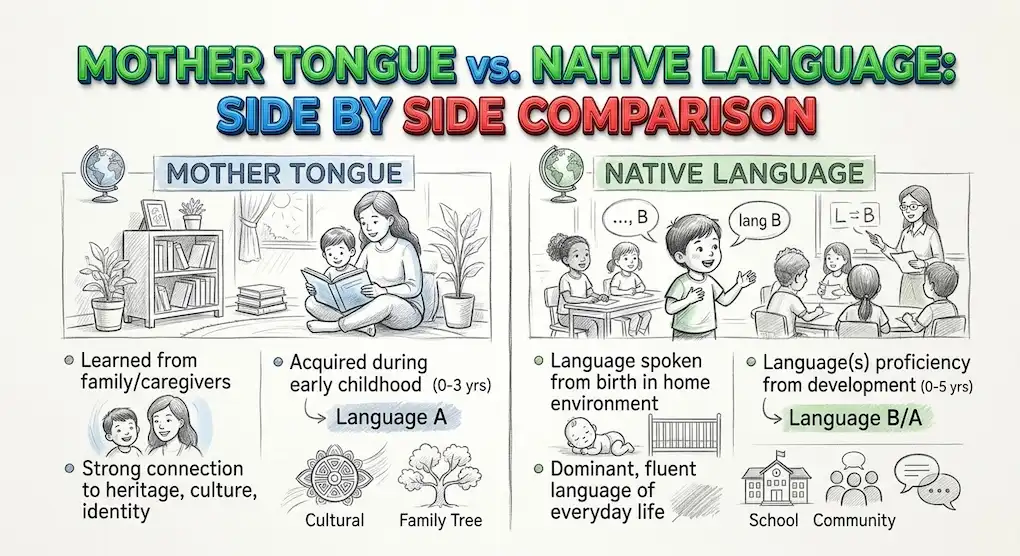
Mother Tongue vs Native Language: Side by Side Comparison
The following table summarizes their common meanings and usage.
| Aspect | Mother Tongue | Native Language |
|---|---|---|
| Basic meaning | First language learned during childhood | First language learned during childhood |
| Main emphasis | Often family, upbringing, and identity | Often natural language acquisition |
| Family connection | Commonly associated with home | Not necessarily emphasized |
| Cultural meaning | Can carry cultural associations | Usually more descriptive |
| Childhood learning | Yes | Yes |
| Multiple languages | Can describe more than one | Can describe more than one |
| Everyday usage | Common | Common |
| Formal usage | Suitable when the meaning is clear | Suitable when the meaning is clear |
Remember: This table shows common differences in emphasis, not two completely separate dictionary definitions.
UNESCO’s Institute for Statistics uses home language to describe a language learned during childhood in the home environment and lists mother tongue, first language, and native language as alternative terms.
See the UNESCO Institute for Statistics glossary for this terminology.
Mother Tongue vs First Language vs Native Language
Another expression that frequently appears in language discussions is first language.
A first language is one of the earliest languages a person acquires. Linguists commonly abbreviate it as L1.
Although mother tongue, native language, and first language frequently overlap, each expression can be useful in a particular context.
Mother Tongue vs First Language
Mother tongue commonly identifies a person’s first childhood language and may carry additional associations with family and cultural background.
First language focuses more directly on early language acquisition.
For example:
“English is my first language, but my grandparents speak Urdu.”
This sentence identifies English as the language the speaker learned first. It does not necessarily describe the person’s entire family or cultural background.
Native Language vs First Language
Native language and first language are also frequently used interchangeably.
For example:
“German is his first language.”
“German is his native language.”
Both sentences can describe someone who acquired German naturally during childhood.
However, first language is particularly useful when discussing language acquisition in educational or academic settings.
What Does L1 Mean?
L1 is a linguistic abbreviation for first language.
It appears in discussions about language learning, bilingual education, and second language acquisition.
For example:
- L1: First language.
- L2: Second language.
- L3: Third language.
These labels help describe the order in which someone learns languages. However, a multilingual person may acquire multiple languages at approximately the same time, so the numbers do not always represent a simple learning sequence.
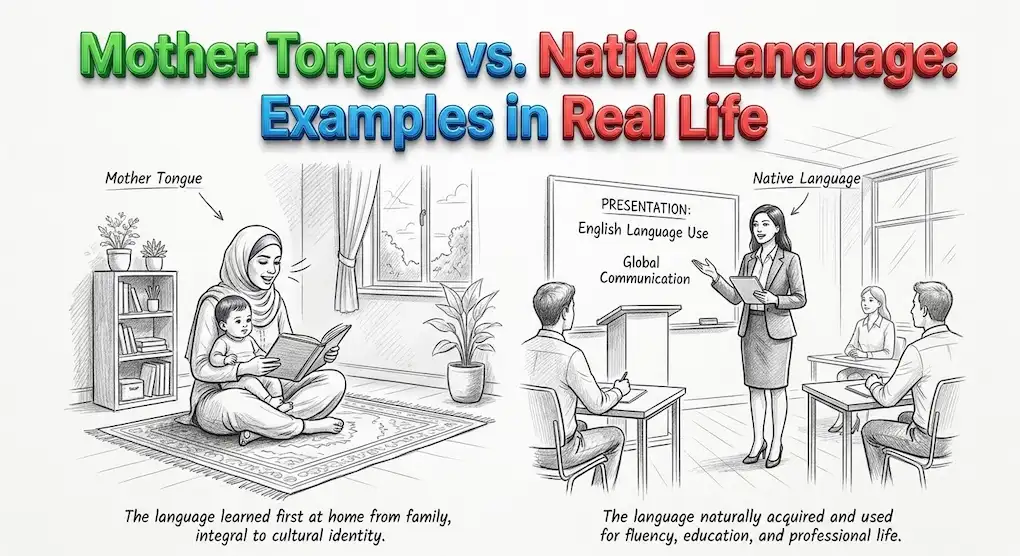
Mother Tongue and Native Language Examples in Real Life
Different childhood experiences help explain why these expressions can overlap.
Example 1: A Child Who Learns One Language
Emma grows up in an English speaking household. Her parents communicate with her in English, and she learns Spanish at school when she gets older.
English is her mother tongue, native language, and first language.
Spanish is an additional language.
In this situation, all three expressions describe the same childhood language.
Example 2: A Bilingual Family
Lucas has a German speaking father and a French speaking mother. Both parents use their languages regularly from infancy.
Lucas naturally develops German and French.
Both languages can be described as his native languages and first languages. Depending on his personal background, he may also identify both as his mother tongues.
A useful description would be:
“Lucas grew up speaking German and French.”
This sentence clearly communicates his bilingual upbringing without forcing him to select only one language.
Example 3: A Heritage Language
Nadia grows up in an English speaking household. Her grandparents speak Arabic, and she learns a few Arabic expressions from them.
Arabic is connected to her family background, so it may be described as her heritage language.
However, this information does not establish that she acquired Arabic as a native language.
English is more clearly her first and native language in this example.
Example 4: Moving to Another Country
A child grows up speaking Italian at home and moves to Australia at age four.
After several years, the child becomes highly comfortable speaking English at school and with friends.
Italian remains connected to the child’s early family language experience, while English may become the dominant language.
The person’s first language and strongest present day language do not necessarily have to be the same.
Mother Tongue vs Native Language in Different Contexts
Both expressions are natural in English. However, the best choice depends on the situation and the meaning you want to communicate.
Everyday Conversation
In casual conversations, you can ask:
“What is your mother tongue?”
Or:
“What is your native language?”
Both questions are understandable.
For example:
“My mother tongue is Urdu, but I also speak English.”
“My native language is Spanish.”
There is no need to explain the difference unless the conversation specifically concerns language acquisition or cultural identity.
Academic Writing
In linguistic and educational writing, first language or L1 may be useful when discussing early language acquisition.
For example:
“Participants reported English as their first language.”
This wording identifies the language acquisition background without relying on cultural associations.
When discussing bilingual development, writers should explain whether the languages were acquired simultaneously or one after another.
Résumés and Job Applications
You may encounter these fields on professional forms:
- Native language
- Mother tongue
- First language
- Languages spoken
- Language proficiency
Answer according to the meaning intended by the form.
For example:
Native languages: Urdu and Punjabi.
Additional language: English.
English proficiency: Advanced.
Remember that native language and language proficiency are not identical. A person can become highly proficient in a language learned later in life.
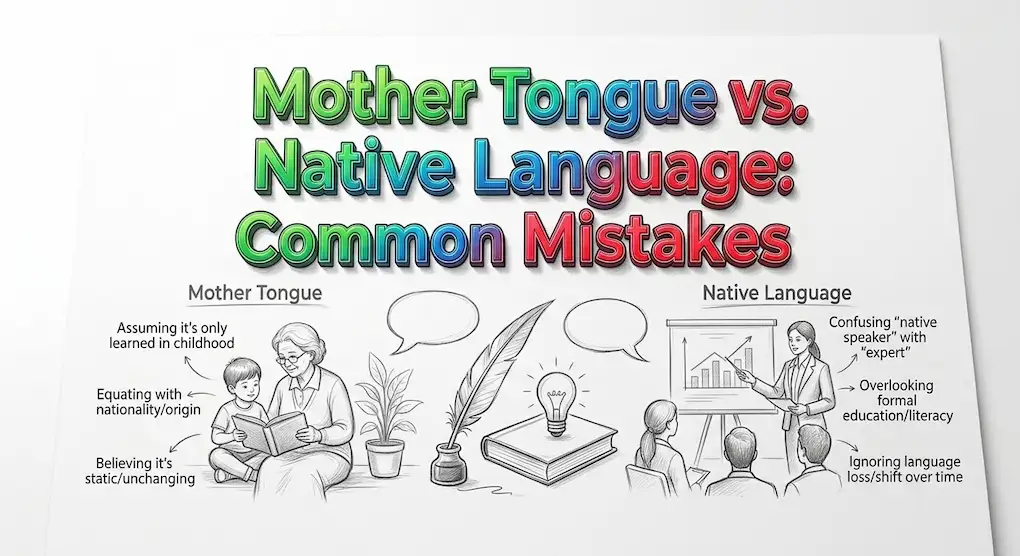
Common Mistakes When Using Mother Tongue and Native Language
Understanding the expressions is easier when you avoid these common misunderstandings.
Mistake 1: Assuming They Always Have Different Meanings
Mother tongue and native language are often synonyms.
It is incorrect to claim that every person has one mother tongue and a completely different native language.
Their meanings overlap, and context determines whether a distinction is useful.
Mistake 2: Thinking Mother Tongue Means Mother’s Language
Your mother tongue does not necessarily have to be the language your mother speaks.
The expression traditionally refers to your first childhood language.
Mistake 3: Confusing Native Language With National Language
A country’s official language is not automatically every citizen’s native language.
Someone may naturally acquire a minority, regional, or family language.
Mistake 4: Assuming Everyone Has Only One Native Language
Some children acquire two or more languages during early childhood.
Therefore, describing only one language as their native language may not fully represent their experience.
Mistake 5: Confusing Native Language With Fluency
Native acquisition and language proficiency are different concepts.
A native speaker may have limited academic writing skills, while someone who learned a language later may develop excellent speaking, reading, and writing abilities.
Mistake 6: Treating Heritage Language as an Exact Synonym
A heritage language is connected to someone’s family or cultural background.
However, the person may not have acquired it naturally as their first language.
For example, someone with Arabic speaking grandparents may grow up speaking English as their native language while maintaining a cultural connection to Arabic.
How to Remember the Difference
You do not need complicated linguistic definitions to remember how these expressions work.
Use these simple associations:
Mother tongue: Think about early upbringing, family, and cultural identity.
Native language: Think about the first language naturally acquired during childhood.
First language: Think about the language or languages acquired earliest.
Heritage language: Think about family and cultural connections.
Dominant language: Think about the language someone currently uses most comfortably or frequently.
For example, a multilingual person might have Urdu as a mother tongue, Urdu and English as native languages, and English as their dominant language today.
This is possible because early language acquisition, cultural identity, and present language use describe different aspects of someone’s experience.
Conclusion
Understanding mother tongue vs native language becomes easier when you recognize that the expressions generally overlap. Both can describe a language acquired during childhood, although mother tongue may carry additional associations with family, home, and cultural identity. Native language commonly emphasizes the first language a person learns. These expressions can also describe more than one language when someone grows up in a bilingual or multilingual environment.
For everyday conversations, either expression is generally appropriate when the meaning is clear. In academic writing, first language or L1 may provide a useful alternative when discussing language acquisition. The best choice depends on the person’s actual language background and the context in which the expression appears. Rather than forcing every speaker into one category, explain their language experience clearly and accurately.
FAQs
Is mother tongue the same as native language?
Yes, the expressions commonly have the same meaning. Both generally refer to the first language someone learns during childhood. Mother tongue may carry additional associations with family, upbringing, and cultural identity, while native language commonly emphasizes early language acquisition. The expressions are often interchangeable in everyday English.
What is the main difference between mother tongue and native language?
The main difference is usually emphasis rather than a strict linguistic distinction. Mother tongue often highlights family and cultural background, while native language focuses on the first language acquired during childhood. However, dictionaries and educational organizations frequently use these expressions as synonyms.
Can someone have two native languages?
Yes. A person can acquire two or more languages naturally during early childhood. For example, a child who regularly hears German from one parent and French from another from infancy may develop both languages as native languages. This is commonly associated with simultaneous bilingualism.
Can you have more than one mother tongue?
Yes. Someone who grows up acquiring two languages from infancy may describe both as mother tongues. The exact terminology can vary between communities and individuals. First languages or native languages may also be useful descriptions for people with multilingual childhoods.
Does mother tongue mean the language spoken by your mother?
No. Mother tongue does not necessarily mean your biological mother’s language. It generally refers to the first language you learn during childhood. You may acquire it from your father, grandparents, siblings, or other caregivers.
Is English my native language if I learned it as a child?
It can be, depending on when and how you acquired it. If you learned English naturally during early childhood through regular exposure and interaction, it may be appropriate to call it your native language. Learning English later through formal instruction generally makes it an additional language.
Is first language better than native language?
Neither expression is always better. First language is often useful in academic and linguistic discussions because it focuses on early language acquisition. Native language is also a natural and widely understood expression in everyday English.
Can your native language be different from your mother tongue?
The expressions are generally used for the same early language, but individual experiences and definitions can create different interpretations. A person may identify strongly with a family language while acquiring another language early in childhood. Explaining that person’s language history can provide greater clarity.
Is a heritage language the same as a native language?
Not necessarily. A heritage language is connected to someone’s family or cultural background. A person may have a heritage language without acquiring it naturally as their first language. For example, someone with Arabic speaking grandparents may grow up speaking English as their native language.
Which term should I use in formal writing?
Use mother tongue when discussing a person’s early language background or cultural connection. Native language is suitable when identifying the first language acquired during childhood. In academic writing, first language or L1 may provide a more precise description, particularly when discussing bilingual or multilingual speakers.

Rebecca Wells is dedicated to improving English grammar and language skills for young learners. Through her insightful articles and educational contributions on Gill Grammar, she strives to help students overcome foundational writing and grammar challenges from the very beginning, ensuring strong language proficiency early in their academic journey.
