
A sentence can contain many nouns, descriptive words, and actions, making it difficult to identify its subject. Choosing the wrong subject can also lead to confusing sentences and incorrect verb forms. Fortunately, a few simple rules make this skill easier to learn. This guide explains the subject in English grammar, its main types, more than 50 practical examples, and the rules you need to write clearer, more accurate sentences.
What Is a Subject in English Grammar?
A subject in English grammar is the noun, pronoun, phrase, or clause that occupies the subject position and tells us what a clause is about grammatically. It often performs an action, but it can also experience an action, describe a condition, or identify something.
Consider these examples:
- Maya reads every evening.
- The puppy slept beside the sofa.
- The soup smells delicious.
- The window was broken during the storm.
- Swimming every morning improves my mood.
In the first sentence, Maya performs the action. Next, the soup is described by the linking verb smells. Third, the window receives the action expressed by the passive verb was broken. The fifth sentence uses an entire phrase as its subject.
A subject is therefore not always the person or thing doing something. Its grammatical role depends on the sentence structure.
Subject and Predicate: What Is the Difference?
The subject identifies the person, thing, or idea being discussed grammatically. The predicate contains the verb and provides information about the subject.
| Sentence | Subject | Predicate |
|---|---|---|
| Birds sing. | Birds | sing |
| Sarah plays tennis. | Sarah | plays tennis |
| The old house looks beautiful. | The old house | looks beautiful |
| Our teacher explained the lesson. | Our teacher | explained the lesson |
| The children are ready. | The children | are ready |
In the sentence “Sarah plays tennis,” Sarah is the subject, while plays tennis is the predicate.
A complete sentence generally expresses a complete thought. In ordinary statements, the subject usually comes before the verb, although questions and other sentence structures may use a different order.
For additional help with sentence structure, explore GillGrammar’s grammar guides.
How to Find the Subject of a Sentence
Finding a subject becomes easier when you follow a consistent process.
Step 1: Find the Main Verb
Look for the word that expresses an action or state.
Example: The little bird sings beautifully.
The main verb is sings.
Step 2: Ask Who or What
Ask who or what sings beautifully.
The answer is the little bird.
Step 3: Identify the Complete Subject
Determine whether the subject includes descriptive words.
In this example, little bird is the simple subject, while the little bird is the complete subject.
Step 4: Check the Sentence Structure
Do not assume the subject always appears first. In questions, the subject may follow an auxiliary verb. In commands, the subject you is often understood rather than written.
Consider these examples:
- Where are the keys?
- Under the table sits a small cat.
- The keys are under the table.
- Close the door. The understood subject is you.
Remember that the nearest noun to the verb is not necessarily the subject. Look at how the words function in the entire clause.
Types of Subjects in English Grammar
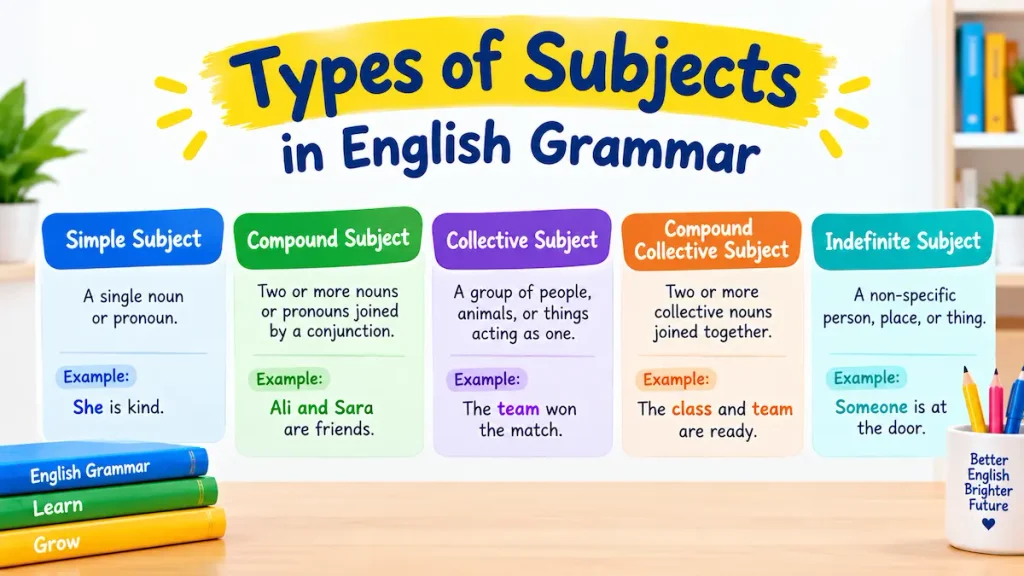
Subjects can take different forms. Understanding these types helps you recognize sentence patterns and choose the correct verb.
1. Simple Subject
A simple subject is the main noun or pronoun that forms the core of the subject. It does not include all the descriptive words surrounding it.
Examples:
- Birds fly across the sky.
- Mia enjoys painting.
- Dogs need exercise.
- Winter brings cold weather.
- Books open new worlds.
- He plays basketball.
- Music makes me happy.
- Teachers help students learn.
In these sentences, the bold word is the simple subject. Notice that a simple subject can be singular or plural.
2. Complete Subject
A complete subject includes the simple subject and the words that describe or identify it.
Examples:
- The curious little kitten chased a butterfly.
- My best friend from school loves science.
- The bright morning sunlight filled the room.
- A group of young musicians performed beautifully.
- The old wooden bridge crossed the river.
- Our new English teacher explained the lesson.
- The delicious chocolate cake disappeared quickly.
- Several colorful birds in the garden sang loudly.
For example, the simple subject in “The old wooden bridge crossed the river” is bridge. The complete subject is the old wooden bridge.
This distinction is especially useful when sentences contain several descriptive words or prepositional phrases.
3. Compound Subject
A compound subject contains two or more subjects that share the same predicate. The subjects are often connected by and, or, or nor.
Examples:
- Emma and Olivia study together.
- My brother and sister enjoy swimming.
- The teacher and the principal attended the meeting.
- Apples and oranges provide vitamins.
- Rain and wind damaged the garden.
- Tom or Jake will answer the question.
- Neither Sarah nor Mia knows the answer.
- The coach and the players celebrated the victory.
A compound subject joined by and generally takes a plural verb. However, subjects joined by or or nor require closer attention because the verb commonly agrees with the nearer subject.
For example, “Either the teachers or the principal is attending” uses is because principal is the nearer subject. In “Either the principal or the teachers are attending,” are agrees with teachers.
4. Pronoun Subject
A pronoun can replace a noun or name and function as a subject. Common subject pronouns include I, you, he, she, it, we, and they.
Examples:
- I enjoy learning new words.
- You have a wonderful idea.
- He works at the library.
- She teaches English grammar.
- It looks beautiful outside.
- We visit our grandparents every Sunday.
- They play soccer after school.
- Someone left a notebook here.
- Everybody enjoyed the celebration.
- Nobody remembered the appointment.
Words such as someone, everybody, and nobody are also pronouns. In standard English, they generally take singular verbs, even when they refer to people in a broad or collective sense.
Learn more about these forms in GillGrammar’s guide to pronouns.
5. Gerund and Infinitive Phrase Subjects
A subject does not always consist of a single noun or pronoun. A gerund phrase or an infinitive phrase can also function as a subject.
A gerund uses an ing form as a noun. An infinitive commonly uses to followed by a base verb.
Examples:
- Swimming in the ocean relaxes me.
- Reading before bedtime improves my vocabulary.
- Learning a new language takes practice.
- Walking every morning helps me feel refreshed.
- Cooking for friends makes her happy.
- To travel around the world is his dream.
- To forgive others requires patience.
- To understand grammar takes time.
In “Reading before bedtime improves my vocabulary,” the entire phrase Reading before bedtime is the subject. The verb improves is singular because the activity is treated as one idea.
Subject Examples in Different Sentence Structures
Recognizing a subject in a basic statement is straightforward. However, questions, commands, and longer sentences require more attention.
Subjects in Questions
Questions often place an auxiliary verb before the subject. The auxiliary helps form the question, but it is not automatically the subject.
Examples:
- Where is your brother staying?
- Why did the baby cry?
- Which student won the competition? Subject: Which student
- What caused the delay? Subject: What
- Who opened the window? Subject: Who
- Are the children ready?
- Has your mother arrived?
- Can the team finish today?
- When will the train arrive?
- Did Sarah complete her homework?
In “Did Sarah complete her homework?” Sarah is the subject. Did is an auxiliary verb, and complete is the main verb.
Subjects in Longer Sentences
Long sentences may contain several nouns, but their grammatical roles differ. A noun inside a descriptive phrase or another clause does not automatically become the main subject.
Examples:
- The students in the front row answered every question correctly.
- My father’s collection of old coins is valuable.
- The woman who lives next door grows beautiful flowers.
- A basket of fresh strawberries sits on the kitchen counter.
- The books on the highest shelf belong to our teacher.
- The team that practiced every morning won the final match.
- The sound of distant thunder frightened the little dog.
- Every student in the classroom received a worksheet.
- The manager of the local store greeted the customers.
- The idea that you suggested yesterday sounds promising.
In the sentence about the basket, basket is the simple subject. Strawberries belongs to the phrase describing the basket, so it does not control the verb sits.
Long sentences can also contain several clauses, each with its own subject. For example, “The girl smiled because her brother told a joke” contains the subject girl in the main clause and brother in the dependent clause.
Essential Subject Grammar Rules
Identifying the subject is only part of the task. You also need to make sure the subject works correctly with the verb.
Rule 1: Match the Subject and Verb
Subject verb agreement means that the subject and verb must agree in grammatical number and person.
Correct: The girl runs every morning.
Incorrect: The girl run every morning.
Correct: The girls run every morning.
Incorrect: The girls runs every morning.
In the simple present tense, third person singular subjects generally take verbs ending in s or es. Plural subjects generally use the base form. The verbs be, have, and do have their own forms.
For more practice, visit Purdue OWL’s subject and verb agreement exercise.
Rule 2: Do Not Let Nearby Nouns Confuse You
A phrase between the subject and verb may contain another noun. That noun does not necessarily determine the verb form.
Incorrect: The list of names are ready.
Correct: The list of names is ready.
The subject is list, which is singular. Names appears in a phrase describing the list.
Similarly, “The quality of these products is excellent” uses is because quality is the subject.
Rule 3: Understand Compound Subjects
Two subjects joined by and generally require a plural verb.
Correct: My mother and father are traveling.
However, two words may represent one combined idea.
Example: Peanut butter and jelly is my favorite sandwich filling.
Here, the expression refers to one sandwich combination. The singular verb is natural when the two items are understood as a single unit.
Rule 4: Recognize the Understood Subject
Commands often leave out the subject because the intended listener is clear.
Examples:
- Close the window.
- Please bring your notebook.
- Remember your homework.
- Turn left at the next street.
The understood subject in each command is you. Writing You before every command is unnecessary, although it can be included for emphasis.
Rule 5: Use the Correct Subject Pronoun
Subject pronouns include I, he, she, we, and they. Object pronouns include me, him, her, us, and them.
Correct: She and I completed the assignment.
Incorrect: Her and me completed the assignment.
In the correct sentence, She and I perform the action expressed by completed. By contrast, in “The teacher helped her and me,” the pronouns function as objects.
Rule 6: Identify Subjects in Passive Sentences
In a passive sentence, the subject receives the action rather than performing it.
Example: The window was broken by the storm.
The subject is the window. The phrase by the storm identifies what caused the damage.
Compare this with the active sentence “The storm broke the window.” Here, the storm is the subject.
Rule 7: Use It and There When Necessary
English sometimes uses it or there as a grammatical subject.
Examples:
- It is raining outside.
- It is important to practice.
- There are three books on the desk.
- There is a problem with the schedule.
In “There are three books on the desk,” there introduces the existence of something. The verb agrees with the following noun phrase in standard usage, which is why are is appropriate for three books.
These structures are useful and grammatically correct. You do not need to remove every sentence that begins with it or there.
Common Subject Grammar Mistakes
Avoiding a few frequent mistakes can improve your writing considerably.
Confusing the Subject With the Object
In “The dog chased the ball,” dog is the subject, and ball is the direct object. The dog performs the action, while the ball receives it.
Choosing the Verb Based on the Wrong Noun
Incorrect: The box of pencils are missing.
Correct: The box of pencils is missing.
The subject is box, not pencils.
Treating Every Plural Meaning as a Plural Subject
Words such as everybody, each, someone, and nobody generally take singular verbs in standard English.
Correct: Everybody knows the answer.
Incorrect: Everybody know the answer.
Leaving Out a Required Subject
A sentence such as “Went to the library after school” lacks an expressed subject in standard formal writing.
Correct: I went to the library after school.
Fragments may be acceptable in informal dialogue, notes, and creative writing, but complete sentences are generally expected in formal assignments.
Misidentifying the Subject in a Question
In “Did your sister call?” your sister is the subject. Did is an auxiliary verb that helps form the question.
Looking at the whole verb phrase rather than the first word will help you identify the subject correctly.
How to Improve Your Subject Grammar Skills
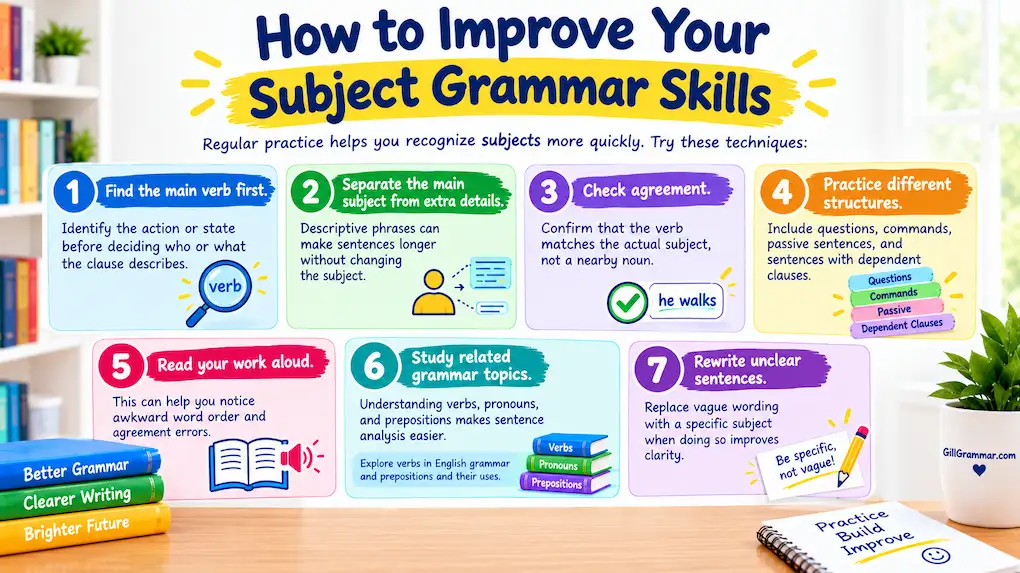
Regular practice helps you recognize subjects more quickly. Try these techniques:
- Find the main verb first. Identify the action or state before deciding who or what the clause describes.
- Separate the main subject from extra details. Descriptive phrases can make sentences longer without changing the subject.
- Check agreement. Confirm that the verb matches the actual subject, not a nearby noun.
- Practice different structures. Include questions, commands, passive sentences, and sentences with dependent clauses.
- Read your work aloud. This can help you notice awkward word order and agreement errors.
- Study related grammar topics. Understanding verbs, pronouns, and prepositions makes sentence analysis easier. Explore verbs in English grammar and prepositions and their uses.
- Rewrite unclear sentences. Replace vague wording with a specific subject when doing so improves clarity.
For example, “The report was completed yesterday” is grammatically correct. If the person responsible matters, “Our team completed the report yesterday” gives the reader more specific information.
Practice Exercise: Identify the Subject
Test your understanding by finding the subject in each sentence before checking the answers.
- The small bird landed on the fence.
- My sister and I enjoy reading.
- Where did the children go?
- Walking after dinner helps me relax.
- The basket of apples is on the table.
- Please open your notebook.
- The homework was completed by Daniel.
- Everyone in the class received a certificate.
Answers and explanations
- The small bird. Bird is the simple subject.
- My sister and I. Two subjects share the predicate, creating a compound subject.
- The children. The auxiliary did comes before the subject.
- Walking after dinner. A gerund phrase functions as the subject.
- The basket of apples. Basket is the simple subject, so the singular verb is is correct.
- You, understood. This is a command directed at the listener.
- The homework. The sentence uses passive voice, so the subject receives the action.
- Everyone in the class. Everyone is the simple subject and generally takes a singular verb.
Try creating your own sentences with each type of subject. Then underline the subject once and the main verb twice. This simple exercise can help you recognize grammatical patterns in everyday reading and writing.
Conclusion
Understanding the subject in English grammar helps you build complete sentences, choose appropriate verbs, and communicate your ideas clearly. A subject can be a noun, pronoun, complete noun phrase, compound structure, gerund phrase, or infinitive phrase. It may perform an action, receive an action, or describe a state, depending on the sentence.
The most useful habit is to identify the main verb and then determine which word or phrase functions as its subject. Pay special attention to questions, commands, passive sentences, and descriptive phrases that contain additional nouns. These structures can make subject identification more challenging, but they become easier with practice.
Use the examples and exercises in this guide to test your understanding. Check subject verb agreement when editing your writing, and review the sentence as a whole instead of relying on word order alone. Whether you are learning English, helping a student, or preparing a professional document, a clear understanding of subjects will support more accurate and natural communication.
Frequently Asked Questions
1. What is a subject in English grammar?
A subject is the word or group of words that functions as the grammatical subject of a clause. It often identifies who or what performs an action, but it can also identify something being described or receiving an action. In “The baby sleeps peacefully,” the baby is the subject.
2. What are the main types of subjects?
Commonly taught subject types include simple subjects, complete subjects, and compound subjects. Subjects can also take the form of pronouns, gerund phrases, and infinitive phrases. These categories describe different structures that perform the subject role in a sentence.
3. How do you find the subject of a sentence?
Find the main verb and ask who or what performs the action or is described. Then check whether descriptive words belong to the subject. For example, in “The young athlete won the race,” the complete subject is the young athlete, and athlete is the simple subject.
4. What is the difference between a simple subject and a complete subject?
A simple subject is the main noun or pronoun at the center of the subject. A complete subject includes that word and its modifiers. In “The cheerful young girl smiled,” girl is the simple subject, while the cheerful young girl is the complete subject.
5. What is a compound subject?
A compound subject consists of two or more subjects that share a predicate. For example, “Emma and Jack play tennis” has the compound subject Emma and Jack. Subjects joined by and generally take a plural verb, while subjects joined by or or nor may require agreement with the nearer subject.
6. Can a phrase function as a subject?
Yes. A gerund phrase or infinitive phrase can function as a subject. In “Swimming in the ocean relaxes me,” the phrase Swimming in the ocean is the subject. In “To learn a language takes time,” To learn a language functions as the subject.
7. Can a sentence have more than one subject?
Yes. A sentence can have a compound subject, such as “The teacher and the students prepared the classroom.” A sentence with multiple clauses can also contain different subjects. For example, “Mia smiled because her brother told a joke” has Mia as the main clause subject and brother as the dependent clause subject.
8. What is subject verb agreement?
Subject verb agreement means that a verb matches its subject in grammatical number and person. For example, “She writes every day” is correct, while “She write every day” is incorrect in standard simple present English. Identifying the true subject helps you choose the right verb form.
9. What is the difference between a subject and an object?
The subject occupies the grammatical subject role, while an object is a noun or phrase that receives an action or completes certain verbs. In “The girl kicked the ball,” the girl is the subject and the ball is the direct object. Their roles change when a sentence is rewritten in passive voice.
10. Can a sentence have an implied subject?
Yes. Commands commonly have an implied subject of you. In “Close the door,” the speaker is directing the listener to act, so you is understood. The pronoun does not need to appear unless the writer wants to add emphasis, as in “You close the door, please.”

As a noted retired professor, James Carter shares his lifelong teaching experience through gillgrammar.com to guide and train students in mastering the English language, helping them overcome challenges with grammar accuracy and fluency so they can achieve academic excellence without facing linguistic hurdles
