
Have you ever wondered who receives a gift, a message, or something given in a sentence? English grammar uses a special sentence element to identify that person or recipient. Understanding an indirect object helps you recognize sentence structure, distinguish different types of objects, and write clearer sentences. In this guide, you’ll learn its meaning, important rules, 50 examples, and simple ways to identify it.
What Is an Indirect Object?
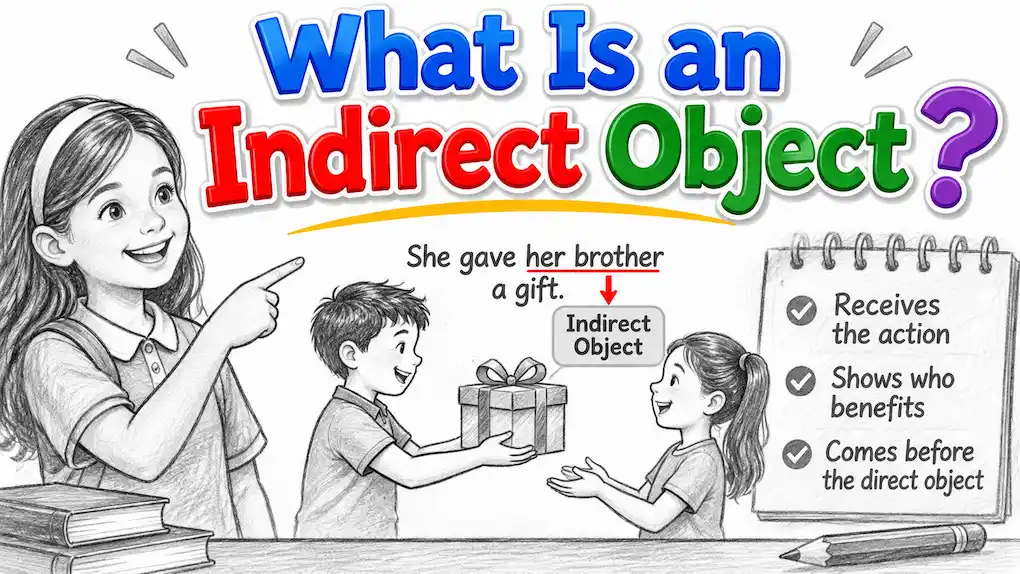
An indirect object is a noun, pronoun, or noun phrase that identifies the recipient of a direct object or the person who benefits from an action.
In simple English, it tells us to whom or for whom something is given, sent, made, or offered.
Consider this example:
Sarah gave her brother a gift.
| Sentence element | Word or phrase |
| Subject | Sarah |
| Verb | gave |
| Indirect object | her brother |
| Direct object | a gift |
Sarah performs the action of giving. The gift is the direct object because it is what she gives. Her brother is the indirect object because he receives the gift.
Here is another example:
Dad bought me a bicycle.
The word me is the indirect object because I receive the bicycle. The word bicycle is the direct object because it identifies what Dad bought.
Indirect Object Meaning in Simple English
The easiest way to understand an indirect object is to remember that it identifies the recipient or beneficiary of an action.
For example:
The teacher gave the students homework.
Ask these questions:
- What did the teacher give? Homework.
- To whom did the teacher give homework? The students.
Therefore, homework is the direct object, and the students is the indirect object.
Remember that an indirect object normally appears with a direct object in the traditional double object construction.
For example, the sentence “The baby slept peacefully” contains no indirect object because the verb slept does not have a direct object.
What Is the Difference Between Direct and Indirect Objects?
A direct object receives the action of a verb, while an indirect object identifies the recipient of the direct object.
Let’s compare them.
| Grammar element | Question | Example |
| Subject | Who performs the action? | Emma |
| Verb | What is the action? | gave |
| Direct object | What was given? | a book |
| Indirect object | To whom was it given? | her cousin |
Example:
Emma gave her cousin a book.
Emma is the subject, gave is the verb, book is the direct object, and cousin is the indirect object.
The direct object identifies what Emma gave. The indirect object identifies who received it.
For more help understanding sentence structure, explore GillGrammar’s guide to subjects in English grammar and predicates in English grammar.
Quick Comparison
Consider these two sentences:
- The coach taught the players a new skill.
- The coach taught a new skill.
The first sentence contains an indirect object, the players, and a direct object, a new skill. The second contains only a direct object.
Both sentences are grammatically correct, but the first provides more information about who receives the instruction.
Important Indirect Object Grammar Rules
Learning a few basic rules makes it easier to recognize and use indirect objects correctly.
Rule 1: An Indirect Object Usually Appears Before the Direct Object
In the common double object construction, the indirect object comes between the verb and the direct object.
The basic sentence pattern is:
Subject + Verb + Indirect Object + Direct Object
Examples:
- Anna gave me a pencil.
- Jack sent his mother a letter.
- Dad bought my sister a backpack.
- The teacher handed us our worksheets.
- Lily showed her friend a photograph.
In each sentence, the recipient appears after the verb and before the thing being given, sent, bought, handed, or shown.
Rule 2: An Indirect Object Normally Appears With a Direct Object
An indirect object identifies who receives the direct object or benefits from the action.
Example:
Mom baked us a cake.
Here:
- Subject: Mom
- Verb: baked
- Indirect object: us
- Direct object: a cake
However, “Mom baked a cake” contains a direct object without an indirect object.
Rule 3: An Indirect Object Can Be a Noun or Pronoun
An indirect object does not have to be a person’s name. It can be a common noun, proper noun, noun phrase, or object pronoun.
Examples:
- The teacher gave Michael a certificate.
- Grandma made the children cookies.
- Dad bought me a jacket.
- The manager offered the employees extra training.
The highlighted words identify the recipients or beneficiaries.
Rule 4: Use Object Pronouns Correctly
When a pronoun functions as an indirect object, use its object form.
| Subject pronoun | Object pronoun |
| I | me |
| You | you |
| He | him |
| She | her |
| It | it |
| We | us |
| They | them |
Examples:
- The teacher gave me a notebook.
- Dad bought her a new dress.
- We sent them an invitation.
- Please show us the instructions.
Incorrect: She gave I a present.
Correct: She gave me a present.
Rule 5: Some Verbs Use To, While Others Use For
Many sentences containing an indirect object can be rewritten using a prepositional phrase beginning with to or for.
For example:
- She gave me a notebook.
- She gave a notebook to me.
Another example:
- Mom baked us a cake.
- Mom baked a cake for us.
The choice depends on the verb and the intended meaning. You generally give, send, or show something to someone, while you often make, buy, or bake something for someone.
These alternative sentences have different grammatical structures. In the second versions, the recipient is the object of the preposition, not an indirect object in the traditional double object construction.
For additional information, read the University of Wisconsin’s explanation of objects.
How to Identify an Indirect Object in a Sentence
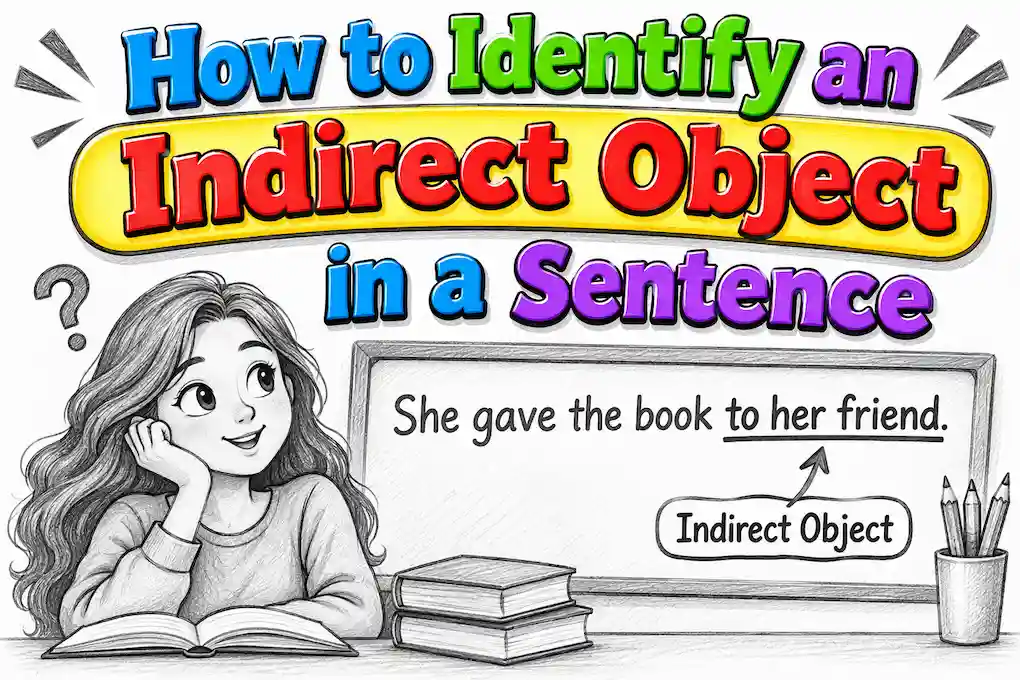
Finding an indirect object becomes easier when you follow a simple process.
Consider this example:
Olivia sent her teacher an email.
Follow these steps.
Step 1: Find the Subject
Ask who performs the action.
Who sent the email?
Answer: Olivia.
Therefore, Olivia is the subject.
Step 2: Identify the Verb
Find the action performed by the subject.
What did Olivia do?
Answer: Sent.
Therefore, sent is the verb.
Step 3: Find the Direct Object
Ask what Olivia sent.
Answer: An email.
Therefore, an email is the direct object.
Step 4: Find the Indirect Object
Ask who received the email.
Answer: Her teacher.
Therefore, her teacher is the indirect object.
Remember this simple method
Find the subject, identify the verb, locate the direct object, and then find the recipient.
More Examples of Identifying Indirect Objects
| Sentence | Direct object | Indirect object |
| Mia gave her friend a card. | a card | her friend |
| Dad bought me a bicycle. | a bicycle | me |
| The teacher showed us a picture. | a picture | us |
| Mark sent his sister a message. | a message | his sister |
| Grandma told the children a story. | a story | the children |
50 Easy Indirect Object Examples
The following examples demonstrate how indirect objects work in everyday English. The bold words identify the indirect objects, while the italic words identify the direct objects.
1. Simple Indirect Object Examples
These sentences are suitable for beginners and students learning basic English grammar.
- Anna gave me a pencil.
- Jack sent his mother a letter.
- The teacher handed us our worksheets.
- Dad bought my sister a backpack.
- Lily showed her friend a photograph.
- The coach taught the players a new strategy.
- Ben offered his neighbor some help.
- Grandma made the children cookies.
- The librarian lent me a book.
- Mark told his brother a joke.
2. Helpful and Positive Indirect Object Examples
These sentences describe kindness, support, and helpful actions.
- The volunteer offered the family a warm meal.
- Sarah brought her coworker a cup of coffee.
- Our neighbors gave us fresh vegetables.
- The counselor taught the students a helpful technique.
- My aunt sent the children birthday presents.
- The chef prepared the guests a delicious dinner.
- The organization sent the shelter extra supplies.
- Daniel found his sister a quiet study space.
- The nurse brought the patient a clean blanket.
- Mom saved me a slice of cake.
3. School and Learning Indirect Object Examples
Use these sentences to understand how indirect objects appear in classroom situations.
- The principal gave the teachers new schedules.
- Mrs. Davis assigned her class a reading project.
- The tutor gave the student a grammar lesson.
- Our science teacher showed us an experiment.
- The librarian recommended a mystery novel to Mia.
- The instructor taught the beginners basic coding skills.
- The school sent every parent an announcement.
- The professor offered his students extra practice questions.
- The teacher read the children a short story.
- The debate coach gave the team useful feedback.
Notice that the fifth example uses a prepositional phrase. It communicates a similar recipient relationship, but Mia is not an indirect object in that sentence.
4. Family and Friends Indirect Object Examples
These examples show how indirect objects appear in conversations about family, celebrations, and personal relationships.
- Emily wrote her best friend a heartfelt note.
- My brother bought me a birthday gift.
- Grandpa told us stories about his childhood.
- Rachel sent her parents a holiday card.
- The children made their mother a handmade necklace.
- David promised his daughter a special outing.
- My cousin taught me a favorite family recipe.
- Jessica brought her grandmother fresh flowers.
- The family gave the newlyweds a photo album.
- Alex read his little brother a bedtime story.
5. Work and Professional Indirect Object Examples
Indirect objects also appear in professional communication, business writing, and workplace conversations.
- The manager sent the employees an updated schedule.
- The assistant sent the director the report.
- The company offered its customers a discount.
- The accountant showed the client the financial statement.
- The supervisor assigned the interns a new task.
- The recruiter emailed the applicant an interview invitation.
- The designer showed the team a new concept.
- The receptionist gave the visitor a registration form.
- The consultant prepared the business owner a marketing plan.
- The team leader showed the staff the new procedure.
These examples demonstrate how the recipient can be a person, a group, or an organization.
How to Use To and For With Indirect Objects
One useful way to understand indirect objects is to compare the two common sentence patterns.
| Double object sentence | Prepositional phrase sentence |
| She gave me a notebook. | She gave a notebook to me. |
| He sent his friend a message. | He sent a message to his friend. |
| Mom baked us a cake. | Mom baked a cake for us. |
| They bought their daughter a dress. | They bought a dress for their daughter. |
| The teacher read the children a story. | The teacher read a story to the children. |
When to Use To
Use to when the sentence describes giving, sending, showing, or communicating something to a recipient.
Examples:
- I sent a message to my brother.
- She gave the documents to her manager.
- The teacher explained the lesson to the students.
- We delivered the package to our neighbor.
- He showed the photograph to his parents.
When to Use For
Use for when someone does something to help, benefit, or provide something for another person.
Examples:
- Mom prepared breakfast for us.
- Dad bought a bicycle for my sister.
- She saved a seat for her friend.
- The chef made dinner for the guests.
- I found a useful book for my teacher.
For more details about prepositions, explore GillGrammar’s guide to prepositions and their functions.
Common Indirect Object Mistakes to Avoid
Some sentence structures can make it difficult to recognize an indirect object. Understanding these mistakes will help you write more naturally.
1. Confusing the Direct and Indirect Objects
Incorrect identification:
Olivia gave the gift her friend.
Correct sentence:
Olivia gave her friend the gift.
In the corrected sentence, friend is the indirect object, and gift is the direct object.
2. Using the Wrong Pronoun
Incorrect: The coach gave they new uniforms.
Correct: The coach gave them new uniforms.
The word them is an object pronoun functioning as the indirect object.
3. Confusing an Object of a Preposition With an Indirect Object
Compare:
Sentence 1: The teacher gave the student a book.
Sentence 2: The teacher gave a book to the student.
In the first sentence, student is the indirect object.
In the second sentence, student is the object of the preposition to.
Both sentences are correct, but their grammatical structures are different.
4. Using an Incorrect Verb Pattern
Some verbs do not normally follow the same double object pattern as give or send.
Incorrect: The tutor explained the student the lesson.
Correct: The tutor explained the lesson to the student.
Similarly:
Incorrect: The librarian recommended Mia a mystery novel.
Correct: The librarian recommended a mystery novel to Mia.
Always check whether the verb accepts the sentence pattern you want to use.
5. Assuming Every Sentence Has an Indirect Object
Not every sentence contains an indirect object.
For example:
- The baby slept peacefully.
- My sister laughed loudly.
- The children played outside.
These sentences do not contain indirect objects.
An indirect object requires an appropriate verb construction and a direct object.
Indirect Objects in Different Writing Situations
Indirect objects are useful in everyday conversations, school assignments, stories, and professional writing.
| Writing situation | Example |
| Everyday conversation | I told him the news. |
| School assignments | The teacher gave us homework. |
| Friendly messages | I sent my friend a photo. |
| Professional emails | I sent my manager the report. |
| Storytelling | Grandma told the children a story. |
| Instructions | Give the instructor your form. |
| Business communication | The company offered its customers a discount. |
The best sentence pattern depends on the verb and the intended meaning. Clear wording should always come before complicated sentence construction.
Practice Exercise: Identify the Indirect Object
Now that you understand the rules and examples, try identifying the indirect objects in these sentences.
Questions
- Sarah gave her brother a gift.
- The teacher showed us a diagram.
- Dad bought me a new bicycle.
- The manager sent the employees an email.
- Grandma baked the children some cookies.
- My friend told me a secret.
- The coach taught the players a new skill.
- Mom saved my sister a seat.
- The librarian lent John a book.
- The company offered its workers extra training.
Answers and Explanations
| Number | Indirect object | Direct object |
| 1 | her brother | a gift |
| 2 | us | a diagram |
| 3 | me | a new bicycle |
| 4 | the employees | an email |
| 5 | the children | some cookies |
| 6 | me | a secret |
| 7 | the players | a new skill |
| 8 | my sister | a seat |
| 9 | John | a book |
| 10 | its workers | extra training |
Learning tip: Find the verb first, identify what is given or received, and then determine who receives it. This simple method will help you recognize indirect objects more confidently.
FAQs
1. What is an indirect object in English grammar?
An indirect object is a noun, pronoun, or noun phrase that identifies who receives a direct object or benefits from an action. For example, in “Lisa gave me a book,” me is the indirect object because Lisa gives the book to me.
2. What is an example of an indirect object?
In the sentence “Tom sent his friend a message,” the words his friend form the indirect object. The word message is the direct object because it identifies what Tom sent. His friend is the recipient of that message.
3. How do you identify an indirect object?
First, identify the subject and verb. Next, ask what the subject gave, sent, made, or offered. Then ask who received that item or benefited from the action. The answer may be the indirect object if the verb and sentence structure allow it.
4. What is the difference between direct and indirect objects?
A direct object receives the action of a verb, while an indirect object identifies the recipient of the direct object. In “Sarah gave her brother a gift,” gift is the direct object, and her brother is the indirect object.
5. Can a sentence have an indirect object without a direct object?
In the traditional double object construction, an indirect object appears with a direct object. For example, “He gave me a pen” contains both objects. However, a recipient can appear in other sentence structures, such as “He spoke to me,” where me is an object of the preposition, not a traditional indirect object.
6. Can an indirect object be a pronoun?
Yes. An indirect object can be an object pronoun such as me, you, him, her, us, or them. For example, in “The teacher showed us a diagram,” us is the indirect object, while diagram is the direct object.
7. Does an indirect object always come before a direct object?
In the common double object construction, the indirect object usually comes before the direct object. For example, “She gave me a notebook.” You can also write “She gave a notebook to me.” In the second sentence, me is the object of the preposition to.
8. Which verbs commonly take indirect objects?
Common verbs include give, send, show, tell, teach, offer, lend, bring, buy, make, promise, and pass. However, a verb’s grammatical pattern matters. For instance, explain generally takes a direct object followed by a phrase beginning with to.
9. What is the difference between an indirect object and an object of a preposition?
An indirect object appears in a double object construction, as in “I sent my friend a letter.” An object of a preposition follows a preposition, as in “I sent a letter to my friend.” In the second sentence, friend is the object of the preposition to.
10. How can students practice indirect objects?
Students can practice by writing sentences about giving gifts, sending messages, teaching lessons, and helping others. First, identify the verb and direct object. Then find the recipient. For example, in “Dad made us breakfast,” us is the indirect object, and breakfast is the direct object.
What to Remember About Indirect Objects
An indirect object helps explain who receives something or benefits from an action. It commonly appears between the verb and direct object, as in “Emma gave her brother a gift.” Here, brother is the indirect object, while gift is the direct object.
Understanding these grammar rules makes it easier to identify sentence elements, use object pronouns, and distinguish indirect objects from objects of prepositions. Remember to check the verb pattern before identifying a recipient as an indirect object.
Practice with everyday sentences about family, school, friends, and work. The more you recognize these patterns, the easier it becomes to write clear and natural English.

As a dedicated academy coach and author, Henry Wilson writes insightful articles on gillgrammar.com focusing on athletic development, discipline, and mental resilience, alongside a strong emphasis on grammar accuracy and a deep passion for teaching, helping to shape and elevate the intellectual and physical potential of students and athletes alike.
