
A direct object is an important part of English grammar because it helps complete the meaning of many sentences. It tells us what or whom a verb refers to. Learning how to identify a direct object can make your sentences clearer and help you understand how subjects, verbs, and objects work together. In this guide, you will learn the meaning, rules, types, and 60 easy examples of direct objects.
What Is a Direct Object?
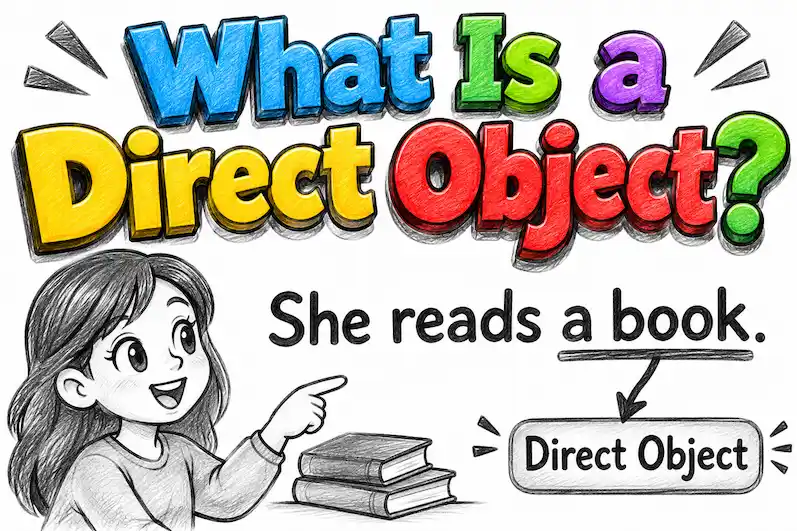
A direct object is a word or group of words that completes the meaning of a transitive verb by identifying what or whom the verb refers to.
In simple terms, it answers the questions what? or whom? after the verb.
Look at this sentence:
Mia reads a book.
- Subject: Mia
- Verb: reads
- Direct object: a book
What does Mia read? She reads a book. Therefore, a book is the direct object.
Here is another example:
James called his friend.
- Subject: James
- Verb: called
- Direct object: his friend
Whom did James call? He called his friend. Therefore, his friend is the direct object.
A direct object usually appears after the verb in an active sentence. However, its position can change in different sentence structures.
How to Identify a Direct Object
Finding a direct object becomes easier when you follow a simple process.
- Find the main verb in the sentence.
- Identify the subject performing the action or being described.
- Ask what? or whom? after the verb.
- Check whether the answer completes the meaning of the verb.
For example:
The children played football.
- Verb: played
- Ask: Played what?
- Answer: football
Therefore, football is the direct object.
Now consider another sentence:
Sarah helped her mother.
- Verb: helped
- Ask: Helped whom?
- Answer: her mother
Therefore, her mother is the direct object.
More Examples of Finding Direct Objects
| Sentence | Question | Direct object |
| Mark opened the door. | Opened what? | the door |
| She painted a picture. | Painted what? | a picture |
| They invited us. | Invited whom? | us |
| I answered the question. | Answered what? | the question |
| He carried the boxes. | Carried what? | the boxes |
Remember that not every verb has a direct object. Some verbs express a complete idea without one.
What Can Be a Direct Object?
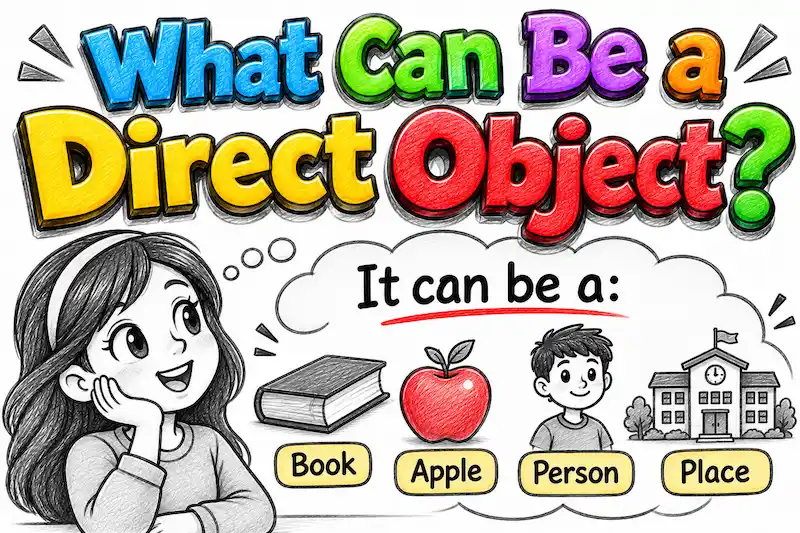
A direct object does not always have to be a single noun. It can take several forms, depending on the sentence.
1. A Noun
A noun can act as a direct object when it identifies what or whom the verb refers to.
Examples:
- She bought a laptop.
- Tom kicked the ball.
- We visited London.
In these sentences, the bold words are nouns functioning as direct objects.
2. A Pronoun
A pronoun can replace a noun and function as a direct object.
Examples:
- I called him.
- She invited them.
- We saw her.
- The teacher praised us.
Notice that object pronouns such as me, him, her, us, and them can function as direct objects.
3. A Noun Phrase
A noun phrase is a group of words built around a noun. The entire phrase can function as a direct object.
Examples:
- She bought a beautiful blue dress.
- He cleaned the large living room.
- We watched an interesting documentary.
Each bold phrase functions as one direct object.
4. A Gerund Phrase
A gerund is a verb ending in ing that functions as a noun. Also a gerund phrase can also be a direct object.
Examples:
- I enjoy reading mystery novels.
- They love playing outdoor games.
- We discussed moving to a new city.
The bold phrases are direct objects because they complete the meaning of the verbs.
5. A Noun Clause
A noun clause is a group of words that acts like a noun. It can function as a direct object when it completes a verb.
Examples:
- I understand what you mean.
- She believes that he is honest.
- We discovered that the store was closed.
In each example, the bold clause functions as the direct object.
Types and Important Forms of Direct Objects
Understanding the different forms of direct objects helps you recognize them in longer sentences.
1. Simple Direct Object
A simple direct object is a single noun or pronoun that receives or completes the meaning of the verb.
Examples:
- She washed the dishes.
- I know him.
- They built a house.
The bold words are the direct objects.
2. Compound Direct Object
A compound direct object contains two or more nouns or pronouns that share the same verb.
Examples:
- She bought apples and oranges.
- The teacher praised Ali and Sara.
- We packed clothes, shoes, and books.
In the first sentence, both apples and oranges are direct objects of bought.
A compound direct object is still part of one sentence structure, even though it contains more than one object.
3. Direct Object Pronouns
Direct object pronouns replace nouns to avoid unnecessary repetition.
Here are some common object pronouns:
| Subject pronoun | Object pronoun |
| I | me |
| We | us |
| You | you |
| He | him |
| She | her |
| They | them |
| It | it |
Examples:
- Sarah knows me.
- I invited him.
- The coach encouraged us.
- We helped them.
The pronouns in bold receive the action or complete the meaning of the verbs.
4. Direct Objects in Questions
Direct objects can also appear in questions. Their position may change, so look carefully at the verb and the answer.
Examples:
- What did you buy? I bought a new phone.
- Whom did she invite? She invited her classmates.
- What did they watch? They watched a movie.
The bold words are direct objects in the answers.
Direct Object vs. Indirect Object
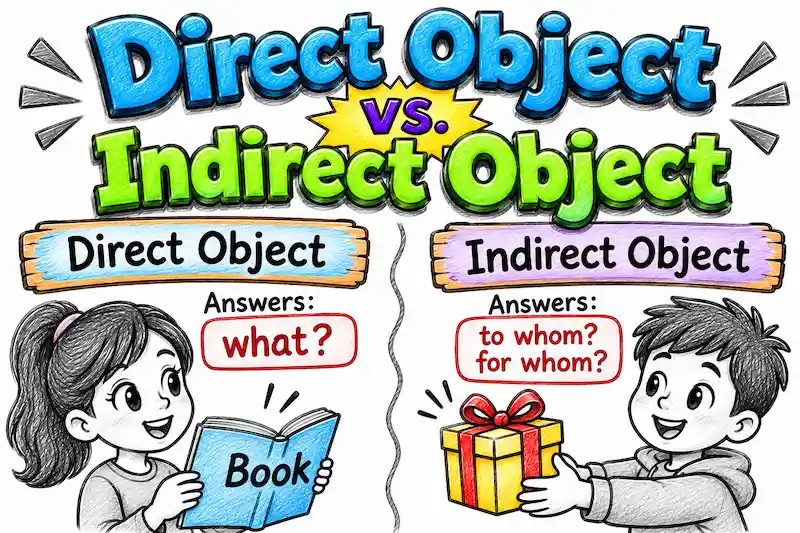
A direct object and an indirect object are not the same. Both can appear in one sentence, but they perform different roles.
A direct object identifies what or whom the verb refers to. An indirect object usually identifies the person or thing that receives the direct object or benefits from the action.
Consider this sentence:
Emma gave her brother a gift.
- Subject: Emma
- Verb: gave
- Indirect object: her brother
- Direct object: a gift
What did Emma give? A gift.
To whom did she give it? Her brother.
Therefore, a gift is the direct object, while her brother is the indirect object.
More Examples
| Sentence | Indirect object | Direct object |
| Dad bought me a bicycle. | me | a bicycle |
| She sent her friend a message. | her friend | a message |
| The teacher gave students homework. | students | homework |
| He told us a story. | us | a story |
Direct Object vs. Object of a Preposition
A direct object should not be confused with the object of a preposition.
An object of a preposition follows a preposition such as in, on, at, with, or under. It does not directly function as the object of the verb.
Compare these sentences:
She admired the painting.
The verb is admired. What did she admire? The painting is the direct object.
She looked at the painting.
Here, at is a preposition. The word the painting is the object of the preposition at, not a direct object.
This distinction is useful when identifying objects in longer sentences.
Direct Object Examples: 60 Easy Sentences
The following examples show how direct objects work in everyday English. The direct objects are shown in bold so you can identify them quickly.
Examples With Nouns
- She bought a new dress.
- John kicked the ball.
- My mother cooked dinner.
- The boy opened the window.
- We watched a movie.
- He repaired his bicycle.
- Sarah cleaned her bedroom.
- They planted flowers.
- I finished my homework.
- The dog chased the cat.
Pronouns
- I called him yesterday.
- She invited them to dinner.
- We helped her with the project.
- The teacher praised us.
- He knows me very well.
- They visited you last week.
- I found it under the table.
- She thanked him for his help.
- The manager selected them.
- My friend reminded me about the meeting.
Noun Phrases
- She bought a beautiful red handbag.
- We visited the old historical building.
- He read an interesting science book.
- They adopted a small brown puppy.
- I prepared a delicious chocolate cake.
- The artist painted a colorful landscape.
- She arranged the fresh garden flowers.
- He carried a heavy wooden box.
- We explored the beautiful mountain village.
- My father purchased a comfortable office chair.
Compound Objects
- She bought bread and milk.
- He invited Ali and Ahmed.
- We packed clothes and shoes.
- The children collected leaves and stones.
- My sister likes tea and coffee.
- They planted roses and tulips.
- I need a pen and a notebook.
- The chef prepared soup and salad.
- She cleaned the kitchen and dining room.
- We watched the news and a documentary.
Examples With Gerund Phrases
- I enjoy reading interesting stories.
- She loves singing classical songs.
- They discussed building a new house.
- We finished cleaning the classroom.
- He avoids eating unhealthy food.
- My brother enjoys playing cricket with friends.
- She practices speaking English every day.
- I dislike waiting for long hours.
- They considered moving to another city.
- We appreciate helping people in need.
Direct Object Examples With Clauses
- I know what you want.
- She believes that he is telling the truth.
- We discovered that the shop was closed.
- He explained why he was late.
- They understand what the teacher said.
- I remember where we first met.
- She knows how the machine works.
- The manager confirmed that the meeting was canceled.
- We learned that practice improves our skills.
- He admitted that he made a mistake.
These examples show that direct objects can appear in different forms. Once you find the verb and ask the right question, identifying the object becomes much easier.
Common Mistakes When Identifying Direct Objects
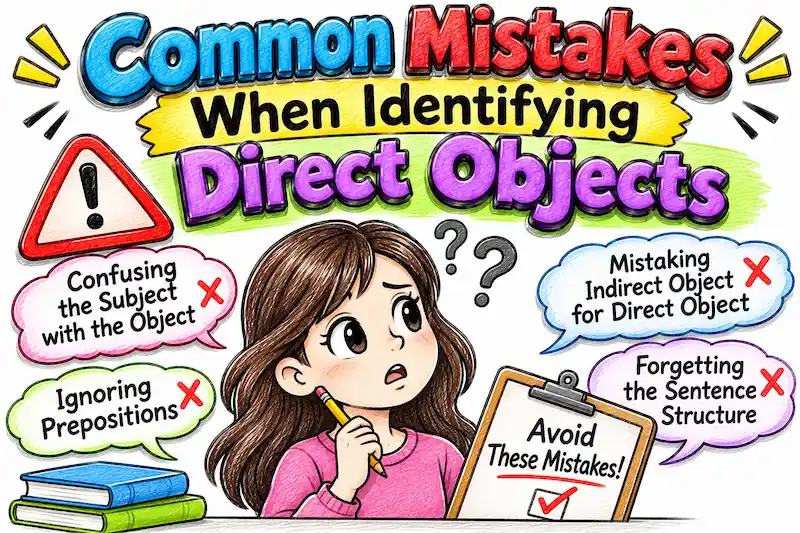
Some sentences contain words that look like direct objects but perform a different grammatical role. Here are common mistakes to avoid.
1. Confusing the Subject With the Direct Object
The subject performs the action or is the person or thing the sentence is about. The direct object completes the meaning of the verb.
Incorrect identification:
Mary reads a newspaper.
- Mary is the direct object.
- A newspaper is the subject.
Correct identification:
- Subject: Mary
- Verb: reads
- Direct object: a newspaper
2. Thinking Every Sentence Has a Direct Object
Not every sentence needs a direct object. Some verbs do not require one.
Examples:
- The baby slept.
- The birds flew.
- The children laughed.
- My grandfather arrived.
These sentences are complete without direct objects.
3. Confusing an Indirect Object With a Direct Object
Consider this sentence:
She sent her mother a letter.
The direct object is a letter, because it answers the question, “What did she send?”
The indirect object is her mother, because it answers the question, “To whom did she send it?”
4. Mistaking an Object of a Preposition for a Direct Object
Look at this example:
The boy sat on the chair.
The word chair follows the preposition on. It is the object of the preposition, not the direct object of the verb sat.
Compare it with:
The boy moved the chair.
Here, the chair is the direct object because it answers the question, “What did the boy move?”
5. Assuming the Direct Object Is Always One Word
A direct object can be a single word, a phrase, or a clause.
Examples:
- She likes music.
- She likes classical music.
- She likes listening to classical music.
- She knows that music can improve her mood.
The bold parts function as direct objects, even though they have different lengths and structures.
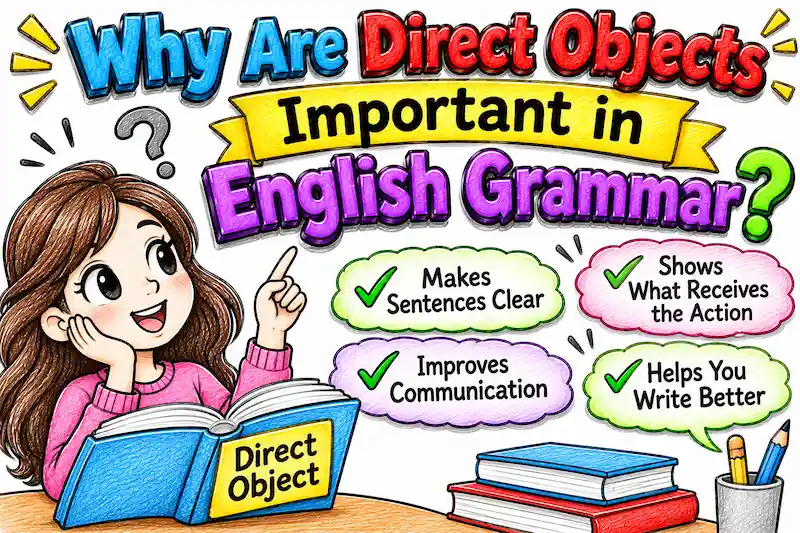
Why Are Direct Objects Important in English Grammar?
Direct objects help make sentences more informative by completing the meaning of many verbs. Without them, some sentences may leave the reader wondering what the subject did or what the action involved.
Compare these examples:
- She bought.
- She bought a new laptop.
The second sentence provides more information.
Learning direct objects can also help you:
- Build clear and complete sentences.
- Recognize the difference between subjects and objects.
- Understand direct and indirect objects.
- Use object pronouns correctly.
- Improve your reading and writing skills.
- Identify sentence patterns more easily.
Direct objects are especially useful when learning transitive verbs, sentence structure, and different parts of speech.
Further Grammar Guidance
If you want to understand objects in more detail, these educational resources offer additional explanations and examples:
- MLA Style Center’s guide to objects explains direct objects, indirect objects, and different grammatical structures.
- University of Wisconsin’s English grammar guide to objects provides explanations of direct objects, indirect objects, and prepositional objects.
These references can help you explore the grammar concepts covered in this article.
Test Your Understanding of Direct Objects
Try identifying the direct object in each sentence. The answers are provided below.
- The girl opened the box.
- My father washed the car.
- We invited our neighbors.
- She enjoys painting pictures.
- He explained why he was upset.
Answers:
- the box
- the car
- our neighbors
- painting pictures
- why he was upset
If you identified all five correctly, you have understood how direct objects work in different sentence structures.
Keep Practicing to Master Direct Objects
Understanding direct objects is an important step toward improving your English grammar. They help complete the meaning of verbs and show what or whom an action refers to. You can find them by locating the verb and asking the questions what? or whom?.
Remember that a direct object may be a noun, pronoun, noun phrase, gerund phrase, or noun clause. It is also important to distinguish direct objects from indirect objects and objects of prepositions. Practice with everyday sentences, and identifying direct objects will gradually become easier. With regular practice, you can write clearer sentences and build a stronger understanding of English grammar.
FAQs
1. What is a direct object in simple words?
A direct object is a word or group of words that completes the meaning of a verb by identifying what or whom the verb refers to. For example, in “She reads a book,” the words “a book” are the direct object because they answer the question, “What does she read?”
2. How do you find the direct object in a sentence?
First, find the main verb. Then ask “what?” or “whom?” after the verb. For example, in “Tom kicked the ball,” ask “Kicked what?” The answer is “the ball,” which is the direct object.
3. Can a pronoun be a direct object?
Yes. A pronoun can function as a direct object when it completes the meaning of a verb. Common object pronouns include me, you, him, her, it, us, and them. For example, in “I called her,” the pronoun “her” is the direct object.
4. What is the difference between a direct object and an indirect object?
A direct object identifies what or whom the verb refers to, while an indirect object usually identifies who receives or benefits from the direct object. In “He gave his sister a book,” “a book” is the direct object, and “his sister” is the indirect object.
5. Can a sentence have two direct objects?
Yes. A sentence can have a compound direct object containing two or more nouns or pronouns. For example, in “She bought apples and oranges,” both “apples” and “oranges” are direct objects of the verb “bought.”
6. Does every sentence have a direct object?
No. Many sentences do not contain direct objects because some verbs do not need them. For example, “The baby slept” is a complete sentence. The verb “slept” does not have a direct object.
7. Can a direct object be more than one word?
Yes. A direct object can be a noun phrase, gerund phrase, or noun clause. For example, in “She bought a beautiful blue dress,” the entire phrase “a beautiful blue dress” functions as the direct object.
8. What is the difference between a subject and a direct object?
The subject is the person or thing the sentence is about and often performs the action. The direct object completes the meaning of the verb. In “John kicked the ball,” John is the subject, while “the ball” is the direct object.
9. What is a direct object pronoun?
A direct object pronoun replaces a noun that functions as a direct object. Examples include me, him, her, it, us, and them. In “Sarah invited them,” the word “them” replaces the names of the people Sarah invited.
10. Can a clause function as a direct object?
Yes. A noun clause can function as a direct object when it completes the meaning of a verb. For example, in “I understand what you mean,” the clause “what you mean” is the direct object of the verb “understand.”

Muhammad Mutahar Hasnat is the founder of gillgrammar.com and a B.Sc. Civil Engineering student. Through his platform, he is dedicated to helping students overcome grammar weaknesses and master English proficiency, ensuring they face no hurdles in digital or any other professional fields and develop a strong command of the language.

1 thought on “Direct Object Examples: Rules and 60 Clear Sentences”