
Grammar mistakes are easy to make when speaking, writing, texting, or learning English. Many errors happen because words sound alike, grammar rules can be confusing, or sentence structures are difficult to remember. Understanding common grammar mistakes helps you recognize incorrect usage, write clearer sentences, and communicate more confidently. The good news is that most grammar errors become easier to avoid when you learn the correct rules and practice them with simple examples.
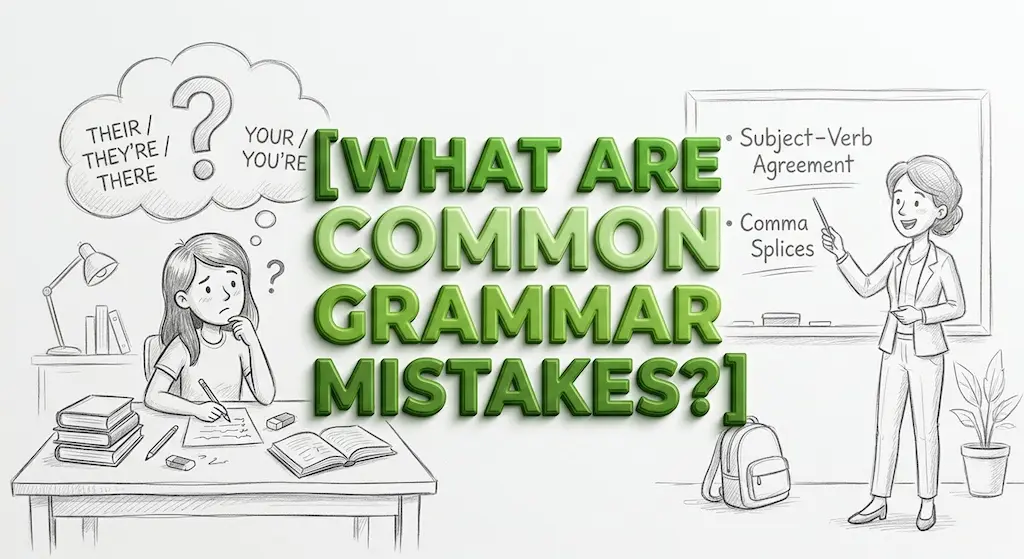
What Are Common Grammar Mistakes?
Common grammar mistakes are errors that people frequently make when forming sentences or using English words. These mistakes may involve subject-verb agreement, verb tense, pronouns, articles, prepositions, punctuation, sentence structure, or confusing words.
For example:
- Incorrect: She go to school every day.
- Correct: She goes to school every day.
The mistake is a subject-verb agreement error. Because she is a singular subject, the present-tense verb needs -s.
Understanding why a sentence is incorrect is more useful than simply memorizing the correction.
1. Subject Verb Agreement Mistakes
The subject and verb in a sentence must agree in number.
A singular subject usually takes a singular verb, while a plural subject takes a plural verb.
Incorrect: The dog run fast.
Correct: The dog runs fast.
Incorrect: The students is ready.
Correct: The students are ready.
Easy Rule
With the simple present tense:
- He works.
- She plays.
- It looks.
- They work.
- We play.
- You look.
Remember that I and you do not take the same verb form as he, she, or it in the simple present.
2. Using “Your” Instead of “You’re”
Your and you’re sound alike, but they have different meanings.
Your shows possession.
- Is this your book?
- I like your idea.
You’re is a contraction of you are.
- You’re very kind.
- You’re doing a great job.
A useful test is to replace you’re with you are.
You’re ready.
→ You are ready.
If the sentence still makes sense, you’re is probably correct.
3. Confusing “Their,” “There,” and “They’re”
These three words are often confused.
| Word | Meaning | Example |
| Their | Shows possession | Their house is large. |
| There | Refers to a place or introduces something | Put the bag there. |
| They’re | Short for “they are” | They’re coming soon. |
Try this simple trick:
- Their = belongs to them
- There = place
- They’re = they are
Incorrect: Their going to the store.
Correct: They’re going to the store.
4. Confusing “Its” and “It’s”
This is another very common grammar mistake.
Its shows possession.
- The cat cleaned its paws.
- The company changed its policy.
It’s is a contraction of it is or it has.
- It’s cold outside.
- It’s been a long day.
Use the same replacement test:
It’s raining.
→ It is raining.
If “it is” works, use it’s.
5. Incorrect Use of Apostrophes
Apostrophes have several purposes, including showing possession and forming contractions.
Correct contractions:
- do not → don’t
- cannot → can’t
- she is → she’s
- they are → they’re
Apostrophes can also show possession:
- Sarah’s notebook
- the teacher’s desk
- the dog’s bowl
But apostrophes generally do not make ordinary plural nouns.
Incorrect: Apple’s are healthy.
Correct: Apples are healthy.
6. Using “Me” Instead of “I”
Choosing between I and me depends on the word’s role in the sentence.
Use I as a subject.
- John and I went shopping.
- My sister and I finished the project.
Use me as an object.
- The teacher helped John and me.
- She invited my brother and me.
A Simple Trick
Remove the other person from the sentence.
John and I went home.
→ I went home.
She called John and me.
→ She called me.
This makes the correct pronoun easier to identify.
7. Confusing “Less” and “Fewer”
In traditional standard English usage, fewer is generally used with things that can be counted individually, while less is generally used with uncountable amounts.
Fewer:
- fewer books
- fewer students
- fewer mistakes
- fewer cars
Less:
- less water
- less time
- less money
- less traffic
For example:
Correct: I made fewer mistakes this time.
Correct: I need less time to finish it.
There are established exceptions and fixed expressions, so real-world usage can sometimes be more flexible.
8. Mixing Up “Then” and “Than”
Then usually relates to time, order, or what happens next.
- We ate dinner, then watched a movie.
- Finish your homework then go outside.
Than is commonly used for comparisons.
- Sarah is taller than Mia.
- This book is more interesting than that one.
A quick reminder is:
Then = time or order
Than = comparison
9. Using the Wrong Verb Tense
English verbs change depending on when an action happens.
For example:
- Present: I walk to school.
- Past: I walked to school.
- Future: I will walk to school.
One common mistake is using a present verb when a past form is required.
Incorrect: Yesterday, I go to the library.
Correct: Yesterday, I went to the library.
Time words such as yesterday, last week, tomorrow, now, and every day can help you identify the appropriate tense.
10. Using “Did” With the Wrong Verb Form
After did or didn’t, use the base form of the main verb.
Incorrect: Did you went there?
Correct: Did you go there?
Incorrect: I didn’t went home.
Correct: I didn’t go home.
The helping verb did already carries the past-tense meaning.
Think of it this way:
did + base verb
- Did you eat?
- Did she call?
- Did they finish?
11. Using “Could of,” “Would of,” or “Should of”
In informal speech, could’ve, would’ve, and should’ve can sound similar to “could of,” “would of,” and “should of.”
However, the standard written forms are:
- could have
- would have
- should have
Or their contractions:
- could’ve
- would’ve
- should’ve
Incorrect: I should of called you.
Correct: I should have called you.
12. Confusing “Affect” and “Effect”
These words can be difficult because both are commonly used in discussions about results and influence.
In many everyday sentences:
Affect is used as a verb meaning to influence.
- Lack of sleep can affect your concentration.
- Weather can affect travel plans.
Effect is commonly used as a noun meaning a result.
- The medicine had a strong effect.
- The decision had an unexpected effect.
There are other meanings and uses, so context matters.
13. Using Double Negatives
A double negative occurs when two negative expressions are used in a way that creates a nonstandard negative construction.
Nonstandard: I don’t need no help.
Standard: I don’t need any help.
Another example:
Nonstandard: She didn’t see nobody.
Standard: She didn’t see anybody.
Some dialects use multiple negatives as part of their grammatical system, but they are generally avoided in formal Standard American English.
14. Confusing “Who” and “Whom”
Who is generally used as a subject.
- Who called you?
- Who wrote this letter?
Whom is traditionally used as an object.
- Whom did you invite?
- To whom should I send the email?
In everyday American English, who is very common in places where traditional grammar would use whom, especially in informal speech.
For formal writing, knowing the traditional distinction can still be useful.
15. Misusing “Good” and “Well”
Good is usually an adjective.
- She is a good student.
- That was a good idea.
Well is commonly an adverb.
- She writes well.
- He performed well.
Compare:
She is a good writer.
Here, good describes the noun “writer.”
She writes well.
Here, well describes how she writes.
16. Confusing “Lay” and “Lie”
These verbs are frequently confused.
Lie means to recline or be in a resting position.
- I need to lie down.
- She lay on the couch yesterday.
Lay means to put or place something somewhere and normally takes an object.
- Please lay the book on the table.
- He laid the keys beside the phone.
The forms can be confusing because lay is also the past tense of lie.
17. Using “Between” With More Than Two Things
A common traditional rule says that between is only for two things and among is for three or more.
Modern English is more flexible.
Between can be used when discussing distinct relationships involving more than two people or things.
- The agreement was made between the three companies.
- She divided her time between several projects.
Among is commonly used when something is considered as part of a group.
- He was sitting among his classmates.
- The prize was shared among the winners.
The choice depends on the meaning, not simply on counting the nouns.
18. Sentence Fragments
A sentence fragment is an incomplete sentence that does not express a complete thought.
Fragment: Because I was tired.
Complete: I went home because I was tired.
Another example:
Fragment: Running through the park.
Complete: The children were running through the park.
Fragments can sometimes be used intentionally in creative writing, advertising, or informal communication. However, they should generally be avoided in formal writing unless they serve a clear stylistic purpose.
19. Run-On Sentences
A run-on sentence occurs when two or more independent clauses are incorrectly joined.
Incorrect: I finished my homework I watched television.
You can correct it in several ways:
Using a period:
I finished my homework. I watched television.
Using a semicolon:
I finished my homework; I watched television.
Using a conjunction:
I finished my homework, and I watched television.
Choosing the right correction makes writing easier to read.
20. Comma Splices
A comma splice happens when two independent clauses are joined only with a comma.
Incorrect: The test was difficult, I studied all night.
Better options include:
The test was difficult, but I studied all night.
The test was difficult. I studied all night.
The test was difficult; I studied all night.
A comma alone is usually not strong enough to connect two complete sentences.
21. Confusing “To,” “Too,” and “Two”
These words sound alike but have different meanings.
To can show direction or be part of an infinitive.
- We went to school.
- I want to learn.
Too can mean “also” or “excessively.”
- I want to go too.
- The soup is too hot.
Two is the number 2.
- I have two pencils.
- She bought two books.
22. Using “Could Care Less” When You Mean “Couldn’t Care Less”
The traditional expression is couldn’t care less, meaning that you have no remaining level of concern.
- I couldn’t care less about the argument.
The phrase could care less is also widely used in informal American English, often with the same intended meaning, but it does not logically express the same idea literally.
For formal writing, couldn’t care less clearly communicates the intended meaning.
23. Incorrect Parallel Structure
Parallel structure means using similar grammatical forms when expressing related ideas.
Incorrect: She likes reading, swimming, and to dance.
The forms do not match.
Correct: She likes reading, swimming, and dancing.
Another example:
Incorrect: The job requires writing reports, answering calls, and to organize files.
Correct: The job requires writing reports, answering calls, and organizing files.
Parallel structure makes sentences smoother and easier to understand.
24. Misplacing Modifiers
A modifier should be placed close to the word it describes.
Consider:
Confusing: Walking to school, the rain soaked Maria.
The sentence seems to say that the rain was walking to school.
A clearer version is:
Walking to school, Maria was soaked by the rain.
Clear modifier placement prevents unintended meanings.
25. Using “There Is” and “There Are” Incorrectly
Use there is with a singular noun and there are with a plural noun in standard formal English.
There is a book on the desk.
There are three books on the desk.
A common mistake is:
Incorrect: There is many reasons to study.
Correct: There are many reasons to study.
In informal speech, “there’s” is sometimes used before plural nouns, but there are is the standard choice in careful writing.
26. Forgetting Articles: “A,” “An,” and “The”
English articles can be challenging for ESL learners.
Use a before a singular countable noun when referring to one nonspecific thing beginning with a consonant sound.
- a book
- a teacher
- a university
Apply an before a singular countable noun beginning with a vowel sound.
- an apple
- an hour
- an interesting story
Use the when referring to something specific or already identified.
- I saw a dog. The dog was friendly.
Article rules depend on meaning and sound, so simply choosing based on the first letter is not always enough.
27. Confusing Adjectives and Adverbs
Adjectives usually describe nouns, while adverbs often describe verbs, adjectives, or other adverbs.
Adjective: She is a careful driver.
Adverb: She drives carefully.
Another example:
- He is a quick learner.
- He learns quickly.
However, not every adverb ends in -ly, and some words can function as both adjectives and adverbs depending on context.
28. Forgetting the Subject in a Sentence
Standard English sentences generally need a clear subject.
Incorrect: Went to the store after work.
Correct: I went to the store after work.
The exception is when the subject is understood in certain constructions, such as commands:
- Sit down.
- Please close the door.
Knowing when a subject is required helps create complete sentences.
29. Using “I Seen” Instead of “I Saw” or “I Have Seen”
Seen normally needs a helping verb such as have, has, or had.
Incorrect: I seen that movie yesterday.
Correct: I saw that movie yesterday.
Correct: I have seen that movie before.
Remember:
- Simple past: saw
- Past participle: seen
The same pattern applies to many irregular verbs.
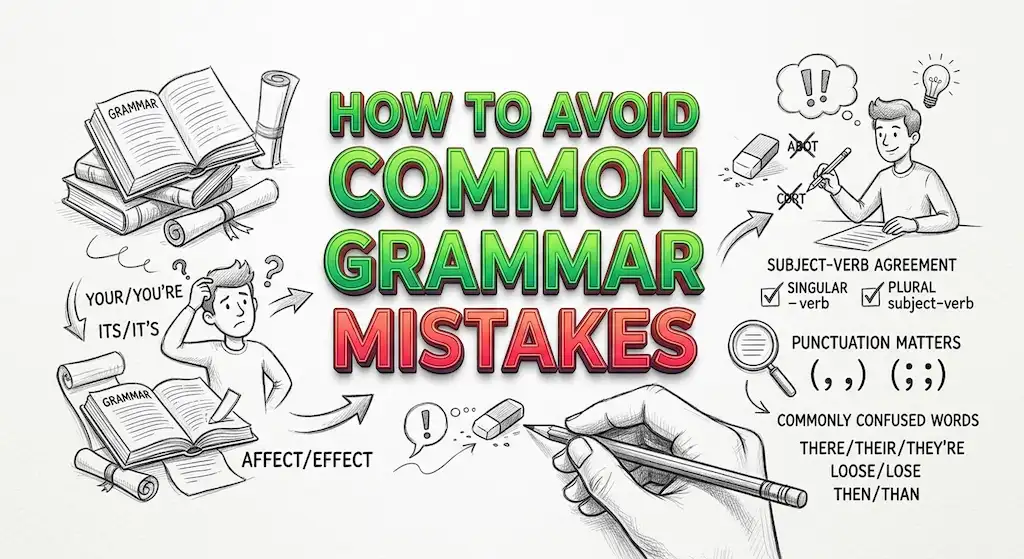
How to Avoid Common Grammar Mistakes
Improving grammar takes practice, but a few habits can make a major difference.
Read Your Writing Slowly
Do not only look at individual words. Read each sentence and ask whether the entire idea makes sense.
Check Subject and Verb Agreement
Find the subject and ask:
Does the verb match the subject?
For example:
The children plays outside.
The subject is children, which is plural, so the correct verb is:
The children play outside.
Watch for Confusing Word Pairs
Keep an eye on words such as:
- your / you’re
- their / there / they’re
- its / it’s
- then / than
- to / too / two
- affect / effect
- fewer / less
Check Verb Tenses
Look for time expressions such as yesterday, last year, now, every day, and tomorrow. Make sure the verb matches the intended time.
Read More English
Reading books, articles, educational websites, and other well-edited material helps you see correct grammar in context.
Practice Writing
Write short paragraphs and review them afterward. Look for one type of mistake at a time instead of trying to correct everything at once.
Common Grammar Mistakes: Quick Reference
| Mistake | Incorrect | Correct |
| Subject-verb agreement | She go home. | She goes home. |
| Your/you’re | Your very kind. | You’re very kind. |
| Their/they’re | Their coming. | They’re coming. |
| Its/it’s | Its raining. | It’s raining. |
| Then/than | Bigger then mine. | Bigger than mine. |
| To/too/two | I have to books. | I have two books. |
| Did + verb | Did you went? | Did you go? |
| Less/fewer | Less mistakes | Fewer mistakes |
| I/me | Me and John went. | John and I went. |
| Apostrophe | Apple’s are tasty. | Apples are tasty. |
Why Learning Grammar Mistakes Matters
Grammar is more than memorizing rules. It helps readers understand your meaning and helps you communicate ideas clearly.
A small grammar error can sometimes change the meaning of a sentence. For example, confusing your and you’re may not prevent someone from understanding you, but repeated mistakes can make formal writing look less polished.
Learning common grammar mistakes can help you:
- Write clearer sentences.
- Communicate more confidently.
- Improve school assignments.
- Create stronger professional writing.
- Understand English sentence structure.
- Avoid confusing word choices.
- Improve your editing skills.
The goal is not to make every sentence sound complicated. Good grammar should make communication clearer, not harder.
Final Tips for Better Grammar
You do not need to learn every English grammar rule at once. Start with the mistakes you make most often and practice correcting them in real sentences.
When you are unsure about a sentence, check the subject and verb, verb tense, pronouns, word choice, and sentence structure. Then read the sentence aloud to see whether it sounds clear and natural.
Most importantly, remember that making mistakes is part of learning. The more you read, write, practice, and review your English, the easier it becomes to recognize and avoid common grammar mistakes.
Conclusion
Learning common grammar mistakes is one of the easiest ways to improve your English writing and communication. Many frequent errors involve subject-verb agreement, verb tenses, pronouns, confusing words, articles, apostrophes, sentence structure, and punctuation. Once you understand the basic rule behind each mistake, it becomes easier to recognize and correct similar errors in your own writing.
The best way to improve is to practice regularly instead of trying to memorize every grammar rule at once. Read carefully written English, write your own sentences, and review them for mistakes. Pay special attention to words that sound alike, such as your and you’re, their, there, and they’re, and to, too, and two.
Remember that grammar is a tool for clear communication. You do not need complicated sentences to write well. By identifying your most common errors and practicing the correct forms, you can gradually become a clearer, more confident English speaker and writer.
FAQs
What are the most common grammar mistakes?
Some of the most common grammar mistakes include subject-verb agreement errors, incorrect verb tenses, confusing your and you’re, their, there, and they’re, and its and it’s, misusing apostrophes, using incorrect pronouns, creating sentence fragments, and joining sentences incorrectly. Learning these common patterns can make everyday writing clearer and more accurate.
How can I avoid common grammar mistakes?
You can avoid common grammar mistakes by learning basic grammar rules, reading regularly, practicing writing, and reviewing your sentences carefully. Check subject-verb agreement, verb tense, pronoun use, confusing words, articles, and punctuation. Reading your work slowly or aloud can also help you notice errors that you might miss when reading quickly.
What is the most common grammar mistake in English?
There is no single grammar mistake that is the most common for every English speaker. Frequently seen errors include subject-verb agreement, incorrect verb forms, pronoun confusion, and mixing up words such as your/you’re and there/their/they’re. The mistakes people make often depend on their age, background, dialect, and experience with English.
What is an example of a common grammar mistake?
A common example is incorrect subject-verb agreement: “She go to school every day.” The correct sentence is “She goes to school every day.” Another common mistake is writing “Your very kind” instead of “You’re very kind.” Understanding why the correction works helps you avoid making the same mistake again.
Why do people make grammar mistakes?
People make grammar mistakes for many reasons. They may be learning English, writing quickly, confusing similar-sounding words, translating directly from another language, or not knowing a particular grammar rule. Even fluent English speakers can make mistakes in informal communication. Regular reading, writing, and editing can help reduce frequent errors over time.
What is the difference between “your” and “you’re”?
Your is a possessive word that shows something belongs to someone, as in “your book.” You’re is a contraction of “you are,” as in “you’re ready.” A useful test is to replace you’re with you are. If the sentence still makes sense, you’re is usually the correct choice.
What is the difference between “their,” “there,” and “they’re”?
Their shows possession, as in “their house.” There commonly refers to a place, as in “the book is there.” They’re is a contraction of “they are,” as in “they’re happy.” Remembering these three basic meanings can help prevent one of the most common word-choice mistakes in English.
How can I improve my grammar quickly?
Start by identifying the grammar mistakes you make most often. Learn the rule behind each one, create several original examples, and practice using the correct form. Reading high-quality English and reviewing your writing regularly can reinforce what you learn. Consistent practice is more effective than trying to memorize many rules in one sitting.
Are grammar mistakes always wrong?
Not necessarily. Some forms that are considered incorrect in formal Standard American English may be accepted in particular dialects, informal speech, or creative writing. Grammar also changes over time. It is important to consider the audience, purpose, and setting. A form may be appropriate in casual conversation but less suitable for academic or professional writing.
What are the best ways to practice grammar?
Useful grammar practice includes writing short paragraphs, correcting sample sentences, completing targeted exercises, reading well-edited English, and reviewing your own writing. Focus on one problem at a time, such as verb tenses or pronouns. Then use the correct forms in original sentences. Regular practice helps grammar patterns become easier to recognize and use naturally.

Muhammad Mutahar Hasnat is the founder of gillgrammar.com and a B.Sc. Civil Engineering student. Through his platform, he is dedicated to helping students overcome grammar weaknesses and master English proficiency, ensuring they face no hurdles in digital or any other professional fields and develop a strong command of the language.
